CNA, Phlebotomy, Medical Assistant & Medication Aide Classes in Fort Worth, Medication Aide & Phlebotomy School Near Arlington: 7505 Glenview Drive, Suite I, N. Richland Hills TX 76180; (682)626-5266
Many adult learners want to either continue their educations and/or retrain for a new career pathway. Therefore, night classes can serve as a very convenient way to pursue all those educational goals that may have been deferred or tossed aside long ago. In essence, evening and night classes allow busy adults to finish the same educational pursuits that they had always wanted to achieve before their lives became somewhat hectic.
Legacy Healthcare Careers offers several affordable 11-day nursing assistant (CNA) night classes in the DFW area between Dallas and Fort Worth, Texas. The next 11-day CNA evening class starts on Monday October 28th with a projected graduation date of November 8th, while another 11-day night CNA class begins later in the month of November. Call (682)626-5266 to enroll in night CNA classes near Dallas and Fort Worth.
Life tends to become busy in ways that can distract people from their long term goals, and if a person is attempting to manage a full schedule, night CNA classes can be really convenient. In an intensely competitive local employment market, the more training an individual has, the merrier his or her job prospects. Job training gives people a competitive advantage. Evening and night classes allow us to continue day routines while fulfilling job training goals during late night hours.
In addition to the extreme convenience, going to night CNA classes can come with a myriad of other positive aspects. Adults with full time jobs who might be unable to get ample time off during the daylight hours to go to classes on a more traditional schedule will need night classes to allow them to retrain for new careers and improve their overall value in the job market. Working while going to school can help offset the cost of classes while still leaving ample time to be with family and friends.
Call (682)626-5266 to either schedule a tour of Legacy Healthcare Careers CNA School and/or ask about enrolling in one of their evening/night CNA classes with a convenient Mid Cities location directly between the DFW cities of Dallas and Fort Worth. The school is located at 7505 Glenview Drive, Suite I, Richland Hills TX 76180.
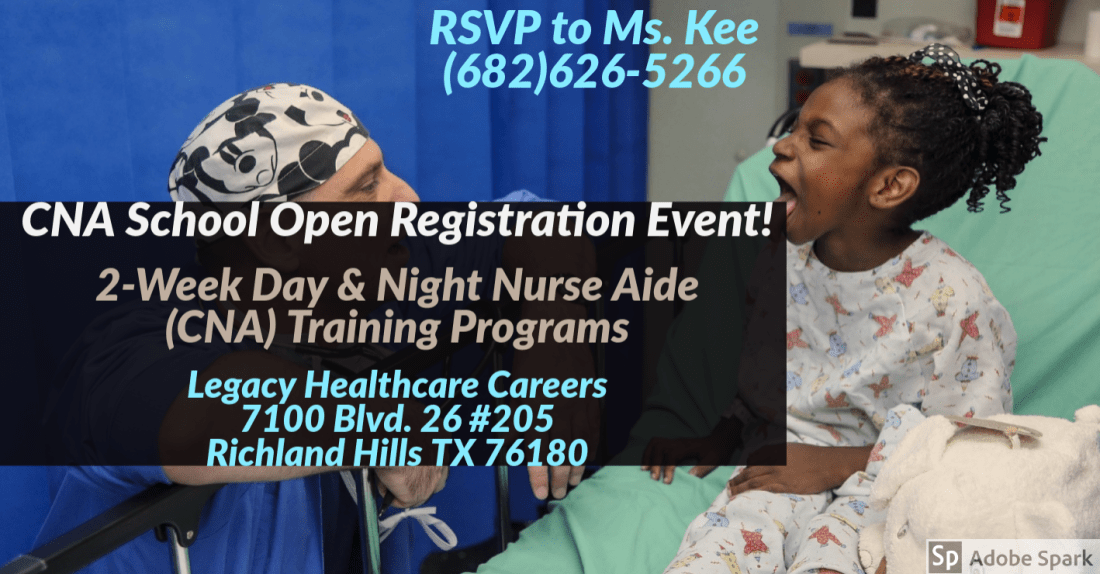
Legacy Healthcare Careers CNA School, a family-owned institution in the Mid Cities section of the DFW metro area, is hosting an open registration event on Friday May 17th from 2:00pm to 5:00pm. The address is 7100 Blvd. 26 #205, Richland Hills TX 76180. This event gives potential students the chance to quickly register for 2-week day and evening certified nursing assistant (CNA) training classes that will begin on May 20, 2019.
As an optional courtesy, please feel free to RSVP to Ms. Kee Randall by telephoning (682)313-6404. Students who enroll in one of the the upcoming 2-week CNA training programs begin coursework on May 20th and graduate just two weeks later on June 3, 2019. As an option, another class begins on June 11th, thereby allowing students to graduate just two weeks later on June 25th.
One of these programs is a daytime CNA class, while the other one is a nighttime CNA class. Therefore, students have their choice of start dates and potential class schedules so as to fit in with peoples’ busy lifestyles outside the school setting. Students who attend CNA classes will be able to continue working their full-time jobs while going to the 2-week CNA programs at Legacy Healthcare Careers.
This is an Open Registration event, so all interested students should arrive prepared by having a picture ID, social security card and a $200 down payment to ensure a seat in one of the upcoming 2-week fast track CNA training programs. Proof of prior education such as diploma, GED, college degree, high school or college transcripts, report card or evidence of 8th (eighth) grade completion will be needed, too.
Legacy Healthcare Careers offers an astounding combination of support services like job placement assistance, resume and cover letter preparation help, hands-on procedural skills practice at no additional charge, and so much more. Students also have access to the school’s 24-hour hotline. In other words, show up to to the Open Registration event at Legacy Healthcare Careers to see what this school has to offer.
Legacy Healthcare Careers is a small family-owned career training school that delivers individualized attention to all students. All of the school’s nurse aide (CNA) training programs are accredited by the Health and Human Services Commission (HHSC) Department of Aging and Disability Services (DADS). The school has approval to operate via the Career Schools and Colleges division of the Texas Workforce Commission (TWC).
Legacy Healthcare Careers CNA School, a small institution in the DFW area of Texas, will be offering 10-day certified certified nursing assistant (CNA) training classes that begin on January 31, 2022. Students who enroll in these fast-track CNA training programs will start their classes on January 31st and graduate a little less than two weeks later on Februuary 9th. One is a daytime CNA class, whereas the other is an evening CNA class.
Students who enroll will be able to continue working their full-time jobs while going to the 10-day CNA classes at Legacy Healthcare Careers. In addition, these nurse aide training classes are can be attended during both the day and night hours. This enables prospective students to select the schedule that fits into their lifestyles most optimally for them. Place a phone call to (682)626-5266 to gather more information or to enroll in classes.
Legacy Healthcare Careers is a very affordable, small trade school that was originally established with the yearning to create a newer generation of competent and compassionate entry-level healthcare workers. The members of instructional staff at Legacy Healthcare Careers are deeply committed to giving new nursing assistants the training that will be the foundation to their blooming careers in the medical sector.
The school’s centrally located Mid Cities campus is convenient to potential pupils who live in Fort Worth, Irving, Arlington, Dallas, Grand Prairie and other cities in and around the Dallas /Fort Worth metro area. The 2-week day and evening CNA classes have been scheduled to work around the lifestyles of busy adult learners while still leaving a lot of free time to spend with family members, loved ones and friends.
The nurse aide training programs at Legacy Healthcare Careers CNA School are all accredited by the Texas Health and Human Services Commission’s (HHSC) Department of Aging and Disability Services (DADS). In addition, Legacy Healthcare Careers has full regulation and institutional approval to operate from the Career Schools and Colleges division of the Texas Workforce Commission (TWC) in Austin, Texas.
Visit the school’s official website, http://www.LegacyHealthcareCareers.com for more info or to submit an online application to begin the enrollment process in one of the 2-week CNA training programs. Interested people can also call Legacy Healthcare Careers at (682)626-5266 or (682)313-6404 for more info on all the awesome things the school has to offer. Job placement assistance is available to all grads.
The following list is a sequence of steps on the proper way to provide foot care to a client during the skills demonstration section of the CNA state examination. Keep in mind that test takers and candidates will be performing the foot care procedural skill on an actual person, not a mannequin.
The candidate knocks on the door.
The candidate identifies the resident.
The candidate introduces himself or herself.
The candidate explains that he or she is there to perform foot care.
The candidate provides for privacy using a door, privacy screen or curtain.
The candidate washes his or her hands.
The candidate gathers the supplies needed to complete foot care.
The candidate places the supplies on the over-bed table.
The candidate places a barrier such as a bed protector or chuck pad on the floor.
The candidate dons gloves.
The candidate removes a sock from one foot and places it on the over-bed table.
The candidate adds warm water to a bath basin.
The candidate checks the water’s temperature with his or her wrist.
The candidate directs the resident to check the water’s temperature with his/her finger or wrist before placing one entire foot in the bath basin.
The candidate applies soap to one wash cloth and gets it lathered up and soapy.
The candidate washes the entire foot, making sure to scrub between the toes.
The candidate rinses the entire foot using another wash cloth with the rinse water from the bath basin, making sure to submerge the resident’s foot in the water.
The candidate removes the resident’s foot.
The candidate pats the foot dry, including the areas between the toes.
The candidate applies a quarter-sized amount of lotion to his or gloved hands and warms it up by rubbing between both hands.
The candidate applies lotion to the resident’s feet, making sure to avoid rubbing any lotion between the toes.
The candidate must wipe away any excess lotion.
The candidate cleans the resident’s area and removes the supplies.
The candidate rinses the bath basin and dries it with a clean paper towel.
The candidate places the bath basin and supplies in the appropriate area.
The candidate places all dirty linens in the hamper and and throws away any trash that may have accumulated.
The candidate removes his or her gloves and discards them.
The candidate places the bed in the lowest position.
The candidate places the call light or signaling device within reach.
The candidate opens the door or privacy screen.
The candidate asks the resident if anything else is needed before he or she leaves the room.
The candidate washes his or her hands.
The candidate documents the procedure and announces that the skill is complete.
An Open Registration event will take place at Legacy Healthcare Careers CNA School on May 10, 2019 between the hours of 2:00 pm and 5:00 pm. The school is conveniently located one mile west of the North East Mall at 7100 Boulevard 26, Suite 205, Richland Hills, Texas 76180, just south of the intersection of Highway 26 and Glenview Drive. As always, parking is free.
As a courtesy, please confirm attendance to the CNA School Open Registration event by placing a call to Ms. Kee Randall to RSVP at (682)626-5266. Of course, walk-in attendees will also be welcomed with open arms. This event offers people the chance to enroll in 2-week nursing assistant (CNA) training classes on the spot. Job placement assistance at Legacy Healthcare Careers is real and begins the very moment pupils enroll in class.
Two certified nursing assistant (CNA) training classes will start on Monday, May 20 with a graduation date of June 3, 2019. Both of these are two-week CNA training programs. The classroom and clinical externship schedules have been tailor-made to specifically accommodate the busy lifestyles of adult learners and pupils who may also who be working full time, raising children and/or have other obligations.
In addition, the schedules have been made to ensure students complete the CNA training program quickly while learning as much material as possible to ensure solid preparation for the entry-level healthcare employment market in the Dallas-Fort Worth Metroplex area. Students who are enrolled in any of the CNA programs at Legacy Healthcare Careers receive 60 hours of classroom instruction and 40 hours of clinical externship.
Since this is an Open Registration event, all potential students should prepare in advance by bringing a picture ID, social security card and a $200 down payment to reserve a seat in one of the upcoming CNA training programs. Proof of prior education such as a high school diploma, GED, college degree, high school or college transcripts, report card or evidence of 8th (eighth) grade completion is also needed.
Legacy Healthcare Careers provides a dynamic blend of support services to their current students and graduates such as job placement assistance, help with resume and cover letter preparation, hands-on procedural skills practice at no additional charge, and so much more. Students also have access to the school’s 24-hour hotline. Come to the Open Registration event at Legacy Healthcare Careers to see what this school has to offer.
Legacy Healthcare Careers is a small family-owned career training school that provides pupils with individualized attention. The school’s nurse aide training programs are accredited by the Health and Human Services Commission (HHSC) Department of Aging and Disability Services (DADS). The school has approval to operate via the Career Schools and Colleges division of the Texas Workforce Commission (TWC).
All of the healthcare training programs offered by Legacy Healthcare Careers are cost-conscious, extremely affordable, convenient and fast track. The instructors at Legacy realize that students have lives outside the school setting, so they make every effort to treat people with the utmost respect, kindness and empathy. Jump-start your legacy now by telephoning (682)626-5266 to transition into a new healthcare career.
Legacy Healthcare Careers proudly joins the lengthy list of organizations to celebrate National Nurses Week 2019, observed during the week of May 6th through May 12th. The point of this week-long observance to bring attention to the importance of the nursing profession and make the public aware of the central role nurses play in the provision of healthcare to people across the country.
National Nurses Week takes place once a year beginning on May 6, also known as National Nurses Day, through the end of the day on May 12, the date of birth of Florence Nightingale, founder of the modern day nursing profession. National Nurses Week is a time for all stakeholders to take note of the useful contributions and beneficial impact of America’s 4 million registered nurses and 1 million licensed practical nurses.
Moreover, National Nurses Week 2019’s theme is “4 Million Reasons to Celebrate.” Join Legacy Healthcare Careers in celebrating the unspoken contributions of nurses in the US, who remain at the helm of enhancing patient care and changing the healthcare system for the better. After all, nurses are the backbone of the healthcare system in the US, so they deserve recognition for all the great things they routinely do.
Some nurses may be wondering where they can receive free or deeply discounted food items during National Nurses Week. Well, these bargain-hunters are in luck because the following retailers are offering freebies to licensed nurses this week.
Cinnabon will give out one free MiniBon roll or a four-count order of BonBites to nurses who display their workplace ID badges until Friday, May 10th.
Cotton Patch Cafe will grant nurses a whopping 20% discount on all orders until Friday, May 10th when they display their workplace ID badges.
Some participating Dunkin’ Donuts locations will give out one free 16 ounce roast iced coffee between the hours of 4:00pm to 10:00pm through May 12th to all nurses who display their workplace ID badges.
Nurses who wear their scrubs or work uniforms will receive a free fountain drink or cookie at the Potbelly sandwich shop throughout this week. Also, the Potbelly is offering a buy one /get one free deal on sandwiches for nurses this week.
Einstein Bro’s Bagels will give a free breakfast to nurses on May 11th as long as they are dressed in scrubs or present their workplace ID badges.
Chipotle is offering a buy one-get one 50% off deal for healthcare professionals on Wednesday, May 8th.
May is Mental Health Awareness Month. Since mental health issues can directly affect a person’s body, mind and spirit, this piece brings up the importance of getting rid of the pervasive stigma associated with mental illnesses. This month-long observance had been started 70+ years ago by Mental Health America to boost awareness regarding mental health issues and emphasize the significance of optimal mental health for all people.
The observation of Mental Health Month has several goals. For one, this observance is a respectful way to support the millions of nameless Americans whose lives are affected by mental health issues. One more goal of Mental Health Month is to bolster the public’s understanding of the intricacies connected with mental illness. Finally, Mental Health Month is a way to eliminate myths and educate people on mental health issues.
Those who work in the healthcare field are exposed to patients and clients with mental health issues all the time. In fact, it is estimated that approximately half of all elderly nursing facility residents are afflicted with depressive disorders. Depression is the most prevalent mental health disorder since it affects an estimated 300 million individuals; in addition, it tends to strike women more often than men (DuBois-Maahs, 2018).
Other common mental health conditions that are seen in the healthcare system with striking regularity include bipolar disorder, anxiety disorder, schizophrenia, obsessive compulsive disorder (OCD), and dementia. Clients who are afflicted with these mental health issues deserve to be seen in a nonjudgmental manner by healthcare providers and allied healthcare workers who have solid understandings of their afflictions.
To spread awareness of Mental Health Month and show support for the millions of sufferers of mental health problems, individuals can take the following actions.
Utilize the hashtags #MentalHealthMonth2019, #mentalhealth, #anxietysupport, #MentalHealthMonth and #depressionsupport when posting on social media outlets such as Instagram, Facebook and Twitter as much as reasonably possible during the month of May.
Re-post and repeat informative facts on mental health issues. For instance, people might be surprised to find out for the first time that depression is the most common mental health problem for women, and that women are afflicted with depression at twice the rate of men.
Send supportive greeting cards and/or letters to your local psychiatric hospital. Direct these greeting cards and letters to the attention of patients and patient care staff so they will be more likely to be received by the intended recipients.
The title of this piece says it all: certified nursing assistants, better known as CNAs, are often promoted to specialized, supervisory or lower management positions in the long term care setting. The varied positions that CNAs are promoted to generally come with alluring perks such as increases in pay, daytime work hours, some authority, chances for career mobility, and more desirable job duties and responsibilities.
So, what types of promotions can CNAs in the long term nursing facility setting receive? CNAs who start their careers in the long term care setting can be promoted into the roles of staffing coordinator, restorative nursing assistant, medical records clerk, shower aide, and central supply manager. These roles all entail some degree of autonomy and require the CNA to be a motivated self-starter with an eagerness to learn new things.
CNAs Can Be Staffing Coordinators
Staffing coordinators are utilized by both hospitals and nursing homes to be responsible for the smooth coordination of schedules and staffing by making sure all shifts at a healthcare facility are covered with adequate numbers of staff members. They closely work alongside nurse managers and supervisors to predict staffing needs and ensure the projected numbers of staff members will be available to cover shifts.
CNAs Can Be Restorative Nursing Assistants
A restorative nursing assistant, often called a restorative nurse aide, is a multi-skilled allied healthcare worker who is trained in the provision of restorative care tasks to patients under the supervision of a licensed nurse. A restorative nursing assistant delivers interventions and implements multiple therapies to patients as delegated to them by the nurse who oversees the nursing facility’s restorative nursing program.
CNAs Can Be Medical Records Clerks
A medical records clerk, sometimes known as a medical records technician, works to ensure patients and residents have accurate medical records. Duties involve assembly, processing, maintenance and proper storage of medical records in accordance with medical, administrative and and regulatory mandates to render them easily accessible between healthcare providers, insurance companies, and the rest of the facility staff.
CNAs Can Be Central Supply Managers
In the long term care setting, central supply managers are tasked with purchasing and obtaining supplies that are needed for patient care such as gloves, personal protective equipment, scales, mechanical lifts, beds, linens, mattresses and other medical supplies. A central supply manager stays in constant contact with vendors and suppliers, adheres to administrative budgets, rents equipment, and checks pricing prior to placing orders.
CNAs Can Be Shower Aides
A shower aide is responsible for the task of providing showers and/or baths, as well as other routine grooming care, to specifically assigned residents in the nursing facility setting. Shower aides typically help residents with personal hygiene and grooming. In addition, they sometimes assist with other daily care tasks for residents. They ensure residents receive showers and/or baths in accordance with predetermined schedules.
Do you want to be promoted into one of these healthcare roles one day in the near future? Become a CNA by enrolling in one of Legacy Healthcare Careers’ two-week nurse aide (CNA) training programs. If you are in the DFW area of Texas, call (682)626-5266 to get started.
Certified nursing assistants, also known as CNAs, have a wide variety of options as far as potential workplaces are concerned. The typical CNA has a number of choices for the type of place where he or she can put the culmination of hands-on skills, formal training and book knowledge to good use. Potential workplaces for CNAs include hospitals, clinics, nursing homes, home care, hospice, group homes and assisted living.
CNAs Can Work At Hospitals
Hospitals are common workplaces for CNAs. Hospitals can be split into two categories: general acute care hospitals and specialty hospitals. General acute care hospitals usually have multiple departments such as an emergency room, surgical suites, labor & delivery, postpartum, intensive care units, cardiac catheterization labs, telemetry, orthopedics, and medical-surgical floors.
Specialty hospitals usually admit inpatients who have a specific health condition or fall into a certain age range. The differing types of specialty hospitals include long term acute care (LTAC) hospitals, cancer treatment centers, psychiatric hospitals, post-acute rehabilitation hospitals, children’s hospitals, surgical hospitals, women’s hospitals, rural hospitals, and convalescent hospitals.
CNAs Can Work At Extended Care Nursing Facilities
Extended care nursing facilities, more commonly known as nursing homes, are by far the most typical workplaces for CNAs. The US Bureau of Labor Statistics has indicated that approximately 40% of nurse aides are working in nursing facilities. Extended care nursing facilities are places where the elderly, severely disabled patients, patients with serious illnesses, and others reside to receive care on a long term basis.
CNAs Can Work In Home Care
The nursing specialty of home care includes two distinct categories: home health and private duty. Home health companies regularly employ CNAs to perform basic nursing care and activities of daily living inside clients’ homes. Home health services are usually prescribed by a doctor based on a predetermined medical necessity and funded by Medicare, Medicaid or private health insurance.
Private duty is a type of care normally rendered in the home setting to aged persons or disabled clients who need assistance with activities of daily living. Private duty CNAs may help clients with tasks such as light housekeeping, meal preparation, activities of daily living and companionship. Private duty care is usually not covered by Medicare or Medicaid and, therefore, tends to be paid for by the client.
CNAs Can Work In Clinics
General practice clinics sometimes utilize CNAs since they can be very helpful to the day to day operations of these workplaces. Small clinics often have one or two physicians and perhaps a nurse practitioner or physicians assistant. These providers see many patients and must be freed up from having to do mundane tasks like answer phones, greet patients, and obtain weights and vital signs. CNAs can complete these routine tasks.
CNAs Can Work In Hospice
Hospice care, which is a type of care given to patients with terminal illness, can be provided in many settings such as the client’s home, a hospital, a nursing home, assisted living, or an inpatient hospice house. A CNA hospice job entails provision of end of life care, often at a hospital, other healthcare facility or inside the client’s residence. Hospice CNAs provide basic care and emotional support to clients and their families.
CNAs Can Work In Group Homes
Personal care group homes are small private facilities with fewer than 20 clients where personal care and meals are provided, and staff are available around the clock. CNAs are often employed by group homes to assist clients with activities of daily living such as bathing, meals, dressing, toileting, transfers, and grooming needs. CNAs also provide companionship in this type of workplace setting.
CNAs Can Work In Assisted Living
CNAs regularly work at assisted living facilities where they deliver basic care and assistance to residents. An assisted living facility is a type of center for clients who need assistance, but not as much help as would be provided by a nursing home. Assisted living facilities can have as few as 25 residents or as many as 200+ residents. Assisted living residents tend to live in their own apartments or units and share common areas.
Do you want to become a CNA? You can become a CNA in only two weeks at Legacy Healthcare Careers CNA School in the DFW area of Texas. Call (682)626-5266.
Perineal care, commonly referred to as peri-care, is the routine care that nurses, nursing assistants and caregivers perform on clients’ genital areas and buttocks to maintain cleanliness, eliminate unpleasant odors, and reduce the microorganism count on this part of the body. Perineal care is a state-testable skill that might randomly appear on a candidate’s CNA state exam, so knowing how to do all steps properly is important.
It is crucial that nurse aides know how to perform perineal care correctly since the client’s perineal area has the potential of becoming infected if this skill is not done the right way. Proper perineal care promotes comfort, infection control, safety and privacy. When performing this skill, always provide for the client’s privacy and wipe from front to back to avoid introducing germs from the anus and buttocks into the urinary tract.
Since the client’s comfort should be kept in mind throughout the procedure, be very gentle and careful when performing perineal care because this part of the body can be extremely sensitive to extremes in touch and temperature. The necessary supplies to perform this skill include a pair of gloves, a wash basin, lukewarm water, soap, six wash cloths, two bath towels, and two bed protectors (also known as ‘chucks’).
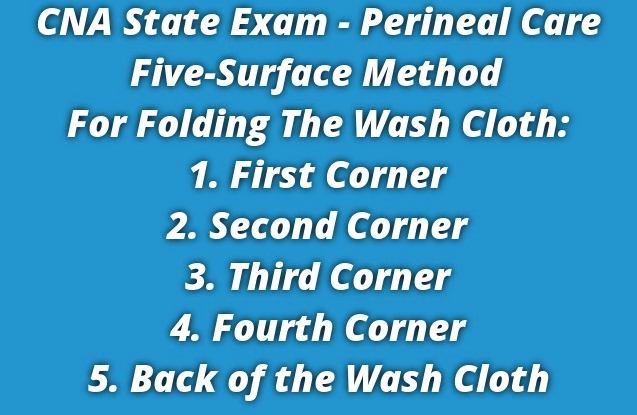
To maintain cleanliness and prevent infections, take the extra time to use a new part of the wash cloth with each wipe to ensure that a clean area of the cloth is always being used. Legacy Healthcare Careers recommends the five-surface method for using wash cloths while providing perineal care at the CNA state test. If executed the right way, the five-surface method enables nurse aides to use five different parts of one wash cloth.
The five-surface method has a couple of benefits. First of all, it provides a clean part of the wash cloth for each wipe, and this is important for achieving a passing score on the perineal care skill at the CNA state exam. Second of all, it keeps the nurse aide from going through too many wash cloths, and this can be immensely helpful when working at a healthcare facility that experiences ongoing shortages of clean linens.
To use the five-surface method, get a wash cloth and fold it in half, then fold it in half a second time to end up with a smaller wash cloth. Thereafter, hold the wash cloth with the four corners pointed upward. Use the first corner of the wash cloth to wipe one area. Then fold the first corner downward and wipe another area with the second corner. Continue to fold each corner until the back of the wash cloth, which will be used as the fifth wiping surface, is reached.
In essence, the five-surface method purposely involves use of five different parts of the wash cloth for wiping the client while performing perineal care:







 Legacy Healthcare Careers Medication Aide & Nursing Assistant Programs