Texas CNA Skills (Part Eleven): Pearls of Wisdom from Nurse Aides Who’ve Passed the CNA State Examination

Screenshot 2018-12-20 at 12.17.03 AM

Due to legislation that had been enacted and implemented in the late 1980s, nurse aides must obtain state certification as certified nursing assistants (CNAs) if they want to secure employment in certain healthcare facilities that accept federal dollars. The Omnibus Budget Reconciliation Act of 1987, more simply known as OBRA, established the minimum acceptable standards for nurse aide training.

The overarching goal of nurse aide training programs is to sufficiently prepare students in nursing assistant programs with the practical knowledge, clinical skills, and procedures that must be adhered to by members of staff at all skilled nursing facilities that receive federal payments. In simpler wording, OBRA is the very reason that nurse aides must attain CNA certification if they want to work at these types of workplaces.

So, this is the burning question. How in the world does a nurse aide obtain certification as a CNA? The answer to this question is the following: a nurse aide becomes certified in a particular state by passing the national CNA state exam utilized by that state. A wonderful way to become more familiar and confident with the setup of the CNA state exam is to obtain feedback from nurse aides who have taken and passed the test.

The following responses are from multiple nurse aides who possess firsthand experience in regards to taking the CNA state exam. The responses provided by these nurse aides pertain mainly to the successful completion of the skills section of the CNA state exam. Keep in mind that a written (or oral) section of the CNA state exam exists as well.

The individual and collective insights provided by these nurse aides that pertain to the CNA state test are rather enlightening. In addition, readers can learn quite a bit of new information from the varied perceptions and recollections of these nurse aides’ different experiences with the CNA state exam. Therefore, read and pay close attention to recurrent themes within the responses such as the importance of performing the procedural skills using the correct sequence of steps.

NURSE AIDE ONE: “If you mess up on a step or just forget to complete a step, you will simply lose points. If you forget to do a bold step (also known as a critical element step), or perform it wrongly, you fail the entire skill by default. You should be able to pass the CNA state test as long as you remember to perform the bold steps and always do them right.”

NURSE AIDE TWO: “You will need to do the skills in the exact order on the skills handbook or you will not pass. So, in your spare time, practice on other people or dolls until you have each step memorized. If you can memorize each and every move, you will pass your CNA state test with flying colors.”

NURSE AIDE THREE: “Where I live, the person who watches you do the skills on the CNA state test is looking for you to perform the tasks in the order listed on the handbook. If you perform the tasks out of order, but do them right, points get deducted from the total score.”

NURSE AIDE FOUR: “On the CNA state test I did the steps as I had learned them since I knew I would have forgotten to do something really important if I strayed from what I learned. All the steps are there for a reason. So I suggest you instill them into your memory bank as best as you can.”

NURSE AIDE FIVE: “Do all the steps in the exact order for the skills.”

NURSE AIDE SIX: “I took lessons for CNA and each time when I took the skills exam part of the CNA state test, we needed to complete every skill correctly step by step. It is because these steps were placed and organized the right way so as to cut down on the chances of cross contamination and to teach you the best way to do the skills for the best care of the residents.”

Legacy Healthcare Careers Nurse Aide Training School Introduces the 7-Day CNA Program

Screenshot 2018-12-16 at 1.32.37 PM.png

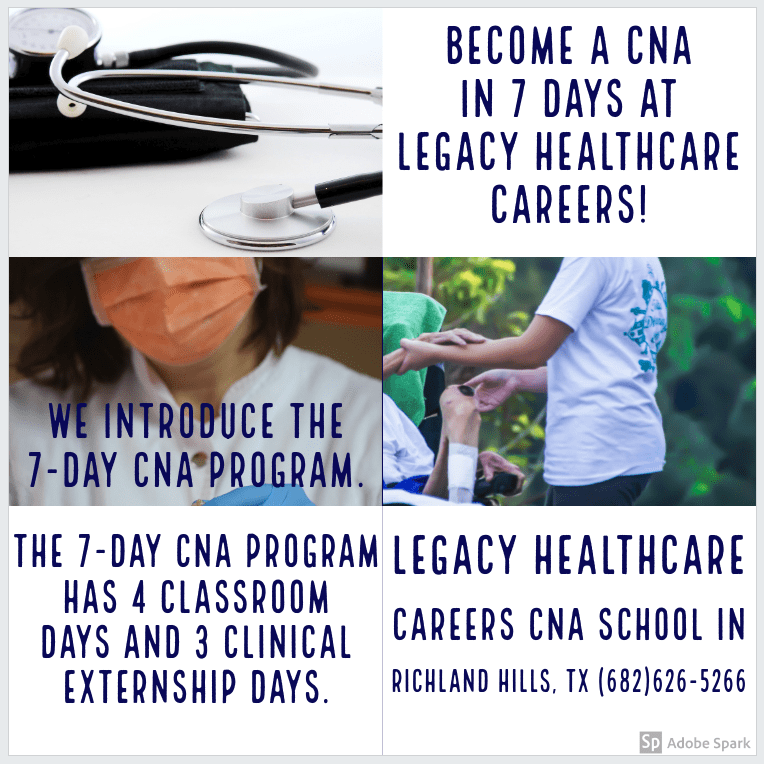
Prospective students who would like to enjoy a rewarding, fulfilling, invigorating healthcare career as a certified nursing assistant (CNA) in the Dallas / Fort Worth area of Texas now have a fast-track option that enables them to accomplish their occupational goals drastically sooner than average. The members of staff at Legacy Healthcare Careers Nursing Assistant School are extremely excited to introduce the 7-day CNA program.

The caring, professional instructors at Legacy Healthcare Careers Nursing Assistant School can assist prospective pupils to convert their career-oriented dreams into reality in as little as 7 days! Those who are ready and willing to devote one long week to their schooling can enter a new and exciting career pathway in only 7 days. Continue reading for more details about this innovative nurse aide training program.

Screenshot 2018-12-14 at 9.59.52 AM.png

The 7-day CNA program entails attending school for seven long days in a row. The 7-day CNA program consists of four days of nursing assistant theory instruction in the classroom setting. The four days of classroom and lab instruction will be followed by three days of hands-on clinical practicum externship at a local healthcare facility in the Dallas / Fort Worth Metroplex area.

After successful completion of the one week of nurse aide training at Legacy Healthcare Careers Nursing Assistant School, students are considered official graduates who are now legally allowed to secure employment as nursing assistants. Once the nurse aide graduate takes and passes both sections of the CNA state test, he or she is granted state certification as a certified nursing assistant (CNA).

The CNA certification opens the doors to an amazing abundance of healthcare employment opportunities associated with steady income and job security. CNAs are in demand in most employment markets in Texas with employment numbers expected to be on the rise through the year 2026 according to projections from the United States Bureau of Labor Statistics.

In addition, due to longstanding reciprocity and endorsement agreements between nursing assistant registries and boards of nursing in different states in the US, the CNA certification bestows an array of marketable job skills upon the nurse aide graduate that can potentially be transferred from region to region.

Please watch the video below for more information regarding the 7-day CNA program. Moreover, interested prospective applicants should feel free to place a telephone call to Legacy Healthcare Careers Nursing Assistant School at (682)626-5266 to schedule a tour of the school and to inquire about enrollment. Prospective students should also feel free to submit an application to the CNA program online by visiting the school’s website at www.LegacyHealthcareCareers.com.

CNAs Must Know About Reciprocity if They Want to Work!

Screenshot 2018-12-14 at 10.53.12 PM

NOTE: The following blog entry is a guest post written by nurse consultant Victoria Randle, APN, NP-C (pictured), proprietor of CNA Instructor Consultants LLC. Ms. Randle can be contacted via email at info@thesecretcocktail.com or on her Facebook page entitled “The CNA Instructors’ Secret Cocktail” (https://www.facebook.com/thesecretcocktail/).

What in the world does reciprocity mean?

When you take the step to further your education and become a CNA, it is important that you know all of your responsibilities associated with this level of education. This encompasses various responsibilities to others, but most importantly to yourself. You must know your scope of practice, your continuing education requirements, how to re-certify and even how or when to obtain reciprocity.

If you are a CNA (certified nursing assistant), you may have heard others talk about reciprocity. What in the world does this word even mean? Reciprocity is the act / process of transferring your CNA certification from one state to another. Believe it or not, each state has its own laws regarding requirements of CNAs that may be different than the state in which you originally obtained your certification.

An example of this may be the number of educational hours needed to become a CNA. The number of educational hours needed to become a CNA differs in each state. For instance, the state of Tennessee requires that a nursing assistant obtain 75 hours of training to become eligible for certification as a CNA. These hours are divided up as follows: 59 hours of classroom /lab practicum and 16 hours of clinical externship.

Let’s say you obtained your CNA certification in Tennessee and decide five years later to move to Texas. Well, Texas requires more hours than Tennessee to become certified as a CNA. In Texas it is required that a CNA must have at least 100 hours of training. These hours are divided up as follows: 60 hours of class/lab practicum and 40 hours of clinical externship. In this case, the CNA is lacking one hour of classroom instruction and 24 hours of clinical instruction.

It is up to the accepting state of Texas to determine if they are willing to accept this CNA’s education from Tennessee for certification as a CNA in Texas. Some states may respond with a solid NO, and therefore require the individual to re-enroll in another CNA program that adheres to the new state’s requirements.

Some states may accept the CNA from Tennessee based on their number of years of experience accrued since obtaining the CNA certification. Other states may accept the CNA pending conditions such as additional training hours, continuing education hours, or the ability of the individual to pass the new state’s CNA state exam.

So, it is extremely important that once you obtain your CNA certification, you become knowledgeable in how many hours you have in classroom versus clinical education. It is also important that if you anticipate moving, you fully understand the new state’s requirements for CNAs. Nothing is worse than moving out of state and having a hard time finding work because you were not aware of how reciprocity works beforehand.

The best of luck to you in your journey to become a CNA. The career is so rewarding! If you are looking to start a CNA school or already own one, maybe I can help. Contact me for consulting assistance for your CNA school. I will be happy to help!

Victoria Randle NP-C, CNA Instructor Consultants LLC

EMAIL – info@thesecretcocktail.com

FACEBOOK – www.facebook.com/thesecretcocktail

WEBSITE – www.thesecretcocktail.com

YOUTUBE – The Secret Cocktail

This is a cordial reminder that if you want to pursue a rewarding, invigorating healthcare career as a nurse aide in the Dallas/Fort Worth area of Texas, the caring members of staff at Legacy Healthcare Careers Nursing Assistant School can assist you in turning your occupational dreams into reality in as little as 7 days! Enroll today.

Legacy Healthcare Careers offers a 7-day CNA program to help jump-start your legacy. Please place a telephone call to our 24-hour hotline at (682)313-6404, visit the school’s website (www.LegacyHealthcareCareers.com) to submit an online application to the CNA program or feel free to browse through the assortment of enlightening blog posts at www.LegacyHealthcareCareers.org for more information about becoming a nursing assistant in just one week.

Screenshot 2018-12-23 at 1.36.55 PM

Texas CNA Skills (Part Ten): General Guidelines for the CNA State Exam

selective focus photo of gray metal folding walker
Photo by rawpixel.com on Pexels.com

The following list is a set of general guidelines to help future nurse aide test takers know what to expect when taking the CNA state test.

  1. Always remember to speak with the patient to whom you are providing care, even if it might be a manikin. Effective communication entails introducing oneself and clearly explaining the procedural skills, which is all part of the skills section of the CNA state test.
  2. Equipment for the procedural skills will be available at the testing center. The nurse aide evaluator will give the test taker a list of all the equipment needed for the procedural skills that will need to be performed. It is the responsibility of the test taker to gather all the equipment. Thus, the test taker should gather and organize all needed equipment in a manner that is easiest for him or her.
  3. At the moment the skills competency section of the CNA state test begins, the test taker is allotted approximately 30 minutes to work through all of the assigned procedural skills.
  4. The test taker is required to wash his or her hands at the beginning of the simulated patient care scenario for the CNA state test. Hand-washing is the first procedural skill to be performed. The test taker is expected to perform hand hygiene by using hand sanitizer at other moments during the CNA state test as needed.
  5. The patient’s privacy and safety must be upheld during the entirety of the simulated patient care scenario. In addition, strict compliance with infection control techniques must be sustained during the entire scenario for the CNA state test.
  6. The test taker will need to physically work through each step associated with every procedural skill he or she has been assigned for the CNA state test. Once the skill is started, if an error is made, the test taker must say so and correct himself or herself. The test taker will be expected to complete the step that was missed.
  7. For the CNA state test, side rails are utilized only for safety with certain procedural skills performances. At other times, the side rails should be in the low position.
  8. Always keep in mind that the CNA state test should be reflective of the test taker’s provision of basic nursing care duties to a real patient and performance of direct hands-on care for that person.
  9. For the skills competency section of the CNA state test, the test taker can be safe to assume that he or she will be performing the skills on one patient and/or manikin and will not be alternating from resident to resident as a typical nursing assistant would in a nursing facility setting. The test taker must become proficient at all of the testable skills in addition to the opening procedures and closing steps for each skill.

REFERENCES

Lewis-Clark State College. (2013). Student Skills Packet. Retrieved from http://www.lcsc.edu/media/117278/2013-Student-Skills-Packet.pdf

Texas CNA Skills (Part Nine): Skills on the CNA State Test that Require Measurements

person filling up the daily report schedule form
Photo by rawpixel.com on Pexels.com

The National Nurse Aide Assessment Program, or NNAAP for short, is a nationwide credentialing program for nurse aides who want to pursue certification as a certified nursing assistant (CNA). In other words, the NNAAP exam is better known as the CNA state test. Additionally, the National Council of State Boards of Nursing (NCSBN) is the entity that has been entrusted with the formulation, revision and administration of the CNA state test.

In most states in the US, the CNA state test is comprised of two distinct sections: a written (or oral) knowledge test made up of 70 multiple choice questions, and a procedural skills competency evaluation consisting of five different hands-on skills that must be demonstrated in front of a nurse aide evaluator.

The procedural hands-on skills evaluation section of the CNA state test takes place in a setting that has been arranged to simulate a patient care environment such as a room inside a long term care facility. Each test taker will have exactly 30 minutes to demonstrate competency in the five skills. The nurse aide candidate must attain a passing cut score on four out of the five procedural skills in order to pass the skills evaluation section of the CNA state test.

The first procedural skill that all test takers in Texas complete is hand-washing, and the remaining four skills will be selected totally at random. Moreover, the NNAAP skills evaluation mandates that all test takers complete at least one numerical measurement skill as part of the CNA state test (Pearson Vue, 2018). All of the hands-on procedural skills that require documentation of a numeric measurement have been listed below.

  1. Measurement and documentation of blood pressure
  2. Measurement and documentation of respiration rate
  3. Measurement and documentation of radial pulse
  4. Measurement and documentation of urinary output
  5. Measurement and documentation of an ambulatory patient’s body weight

https://youtu.be/GLytWvE0TWY

On the scheduled day of the CNA state test, the test taker will need to bring three sharpened number two pencils with erasers to the testing center site to record the numerical measurements. The test taker will also need to bring a wristwatch with a second hand to the testing center to perform certain skills.

During the CNA state test, nurse aide test takers in Texas will be using the following standardized, approved form to document the numerical measurement(s) of the random procedural skill(s) they have been assigned.

Screenshot 2018-12-04 at 10.10.48 PM

REFERENCES

National Council of State Boards of Nursing. (2018). NNAAP & MACE. Retrieved from https://www.ncsbn.org/nnaap-and-mace.htm

Pearson Vue. (2018). Texas Nurse Aide Candidate Handbook. Retrieved from https://home.pearsonvue.com/getattachment/73a0c524-4cbe-401a-aa5c-fe1ebf4e2517/Texas

Texas CNA Skills (Part Eight): What to Wear and How to Dress for the CNA State Test

person performing cpr on dummy
Photo by rawpixel.com on Pexels.com

The broad majority of states in the U.S. have enacted laws that require graduates of nurse aide training programs to pass the respective state-approved examination in order to secure occupational certification as a certified nursing assistant (CNA). Therefore, the CNA state test is extremely important to the future career prospects of countless nursing assistants.

Nonetheless, many nurse aide students remain blissfully unaware that a testing center dress code exists. Well, a dress code certainly does exist for the CNA state test, and more than one rationale for being dressed in a specific way at the testing center site has been presented. The rationales for the dress code have been listed below.

  1. Nurse aide test takers should anticipate the remote possibility of spending all day at the testing center. Therefore, all-day comfort is of the utmost importance.
  2. A nurse aide test taker might be asked to participate in a simulated patient care environment where he or she plays the role of a debilitated elderly patient for one or more other test takers who need to perform hands-on skills. Thus, nurse aide candidates will actually be performing their skills on each other during the skills evaluation section of the CNA state test.
  3. Nurse aide test takers should wear shoes with non-skid soles (bottoms) for safety reasons. The safety of all test-taking candidates needs to be upheld at the testing center.
  4. Any candidate who volunteers to play the role of the patient must wear flat slip-on non-skid closed toe shoes, loose pants or bottoms that are capable of being rolled up, and a loose tank top or loose-fitting shirt with sleeves that can be rolled up to the shoulders (Pearson Vue, 2018).

In general, test takers will never go wrong by dressing the part of an employed nursing assistant regardless of whether or not they opt to volunteer to pose as a patient. The following dress code is more of a basic set of guidelines for appropriate testing center clothing for the CNA state test. Keep in mind that Pearson Vue testing centers are the testing sites where all CNA state tests are conducted in the state of Texas. The following list contains generalities surrounding proper attire in regards to the Texas CNA state test, as well as testing sites in the majority of other states in the US.

  1. Wear closed-toe shoes with flat non-skid soles.
  2. Nurse aide test takers who do not volunteer to play the role of a patient should wear a medical uniform, scrub set, or casual attire. Clothing should be clean.
  3. Nurse aide test takers who choose to wear casual attire should wear jeans, pants, khakis or slacks to comply with the potential need for hands-on skills practice. Dresses and skirts are discouraged with the exception of religious reasons.
  4. Midriffs and abdominal areas should be covered.
  5. Nurse aide test takers should appear clean, groomed, and be free from strong body odor. Perfumes, body sprays and colognes are discouraged.
  6. Nurse aide test takers who wear white bottoms should wear proper underwear since patterned panties, briefs or boxer shorts might be seen through white material.
  7. Long hair should be worn back into a ponytail, bun, contained by a headband, or pinned.
  8. Fingernails should be kept short and trimmed.
  9. Nurse aide test takers must wear a wristwatch with a second hand.
  10. Limit / curtail the amount of jewelry worn to the testing center. The amount of jewelry the nurse aide test taker wears to the testing center site should be minimal.

image (4)

Be completely mindful that the CNA state test dress code is different in a handful of states in the US. For example, CNA state test sites in Arizona require all test-taking candidates to adhere to a very specific dress code, and those who do not comply will not be permitted to take the exam.

With regards to the CNA state test in Arizona, Headmaster LLP (2018) asserts that “SCRUBS (which consists of a scrubs top and scrub pants, scrub skirt (long, loose-fitting) or scrub dress (long, loose-fitting) and closed-toed, soft-soled shoes are the required dress code for testing. You will not be admitted for testing if you are not wearing scrub attire and the appropriate shoes. You will be considered a NO SHOW. You will have to pay for another exam date.”

Be sure to dress for success on the day of the CNA state test and beyond. The nurse aide testing site evaluator is the individual who will be observing for competency as the test taker performs the skills evaluation section of the state test. Dressing the part for the CNA state test can go a long way in presenting the image of a candidate who is fully competent, prepared, professional, and serious about his or her future career as a nursing assistant.

Readers have probably heard the olden adage that one never gets a second chance to make a first impression. The point is to present oneself to the testing site evaluator as a nurse aide who deserves to pass the CNA state test. A cleanly nurse aide candidate looks the part, whereas a test taker with 10 gold chains, a tight-fitting cropped top that exposes the torso and dirty blue jeans does not look professional.

https://youtu.be/fidScEV7qBk

REFERENCES

Headmaster, LLP. (2018). Arizona Nursing Assistant Candidate Handbook. Retrieved from http://hdmaster.com/testing/cnatesting/arizona/azformpages/azforms/AZCandidateHandbook%202.1.18.pdf

Pearson Vue. (2018). Texas Nurse Aide Candidate Handbook. Retrieved from https://home.pearsonvue.com/getattachment/73a0c524-4cbe-401a-aa5c-fe1ebf4e2517/Texas


Texas CNA Skills (Part Seven): Critical Element Steps in the Skills Competency Section of the CNA State Test

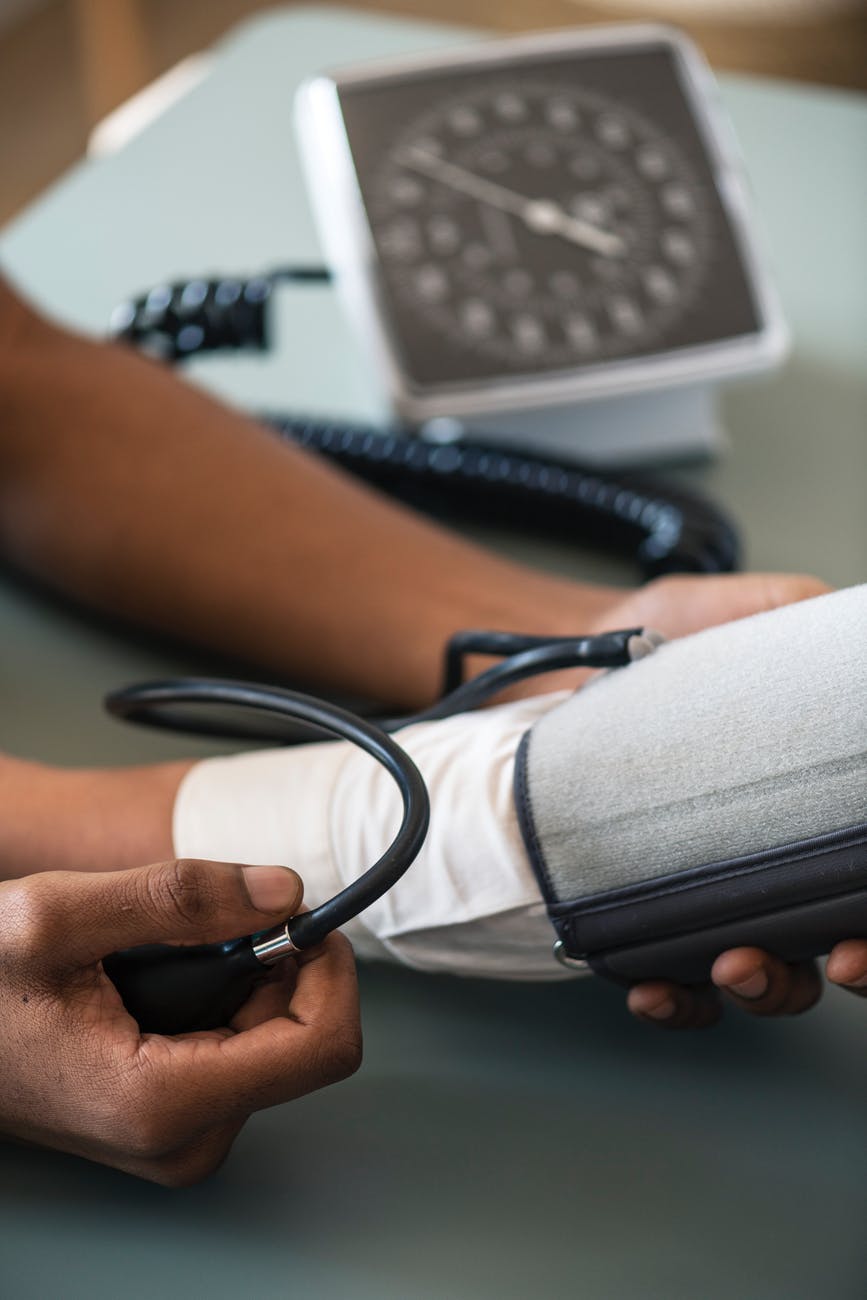
person taking blood pressure
Photo by rawpixel.com on Pexels.com

Nursing assistants who want to obtain certification as a certified nursing assistant (CNA) will need to pass the CNA state examination for the state where they plan to work. In the state of Texas, the CNA state test consists of two sections: a written (or oral) examination with a series of 70 multiple choice questions, as well as a hands-on skills competency evaluation consisting of five procedural skills that are to be performed in the presence of a testing site nurse aide evaluator.

During the skills section of the CNA state test, all test takers will need to successfully perform hand washing as the first procedural skill. Thereafter, the test taker will be required to perform an additional four out of five testable procedural skills. The remaining four testable skills will be selected completely at random.

Before the skills evaluation section of the CNA state test starts, the testing site nurse aide evaluator hands the test taker an instruction card that lists the randomly selected procedural skills that must be completed. Hand washing is the only CNA state test procedural skill that is not selected randomly. In other words, all nurse aide candidates who take the Texas CNA state test will be assigned the skill of hand washing during the skills evaluation portion.

Critical element steps are also referred to as critical steps, key steps, critical items, and critical elements. According to Pearson Vue (2018), critical element steps are the important actions associated with each procedural skill that the test taker must complete with accuracy in order to pass that particular skill. In other words, critical element steps are actions that must always be performed when completing a skill in front of the testing center nurse aide evaluator during the CNA state test.

image (1)

A nursing assistant candidate will most certainly fail the hands-on skills evaluation section of the CNA state test if he or she forgets to perform, misses, or incorrectly performs any critical element steps associated with a particular procedural skill. Also, be advised that most, but not all, skills have critical element steps that need to be correctly done in order to successfully complete the entire procedure with a passing cut score.

As an example, the procedural skill of cleaning an upper or lower denture has no critical element steps associated with it. However, the skill of measuring and recording a patient’s respirations has at least one critical element step attributed to it. Missing, forgetting, or incorrectly completing the critical element step associated with measuring and recording respirations means that the test taker fails the entire skill.

The skill of measuring and recording a patient’s respiratory rate is listed below in a step by step sequence, along with the single critical element step associated with this procedure. The critical element step is emboldened and underlined.

  1. The nursing assistant explains the procedure using clear and slow speech that is understandable. The nursing assistant maintains face to face contact with the client as much as possible.
  2. The nursing assistant measures the client’s respiration rate for one whole minute.
  3. The nursing assistant makes sure that the client’s call bell or signaling device is within reasonable reach.
  4. The nursing assistant washes his or her hands before documenting the client’s respiration rate.
  5. The nursing assistant is to document a respiration rate number that falls approximately within plus or minus two breaths of the testing site nurse aide evaluator’s documented number.

In general, most provisions related to safety, privacy, numerical measurements and infection control are usually regarded as critical element steps for testing purposes while taking the skills competency section of the CNA state test. The test taker cannot miss any critical element steps while performing a hands-on procedural skill at the testing center, or else he or she will automatically fail that particular skill.

In fact, most failures on the skills evaluation portion of the CNA state test can be attributed to the test taker’s omission or forgetfulness of the critical element steps on procedural skills regarding client safety, rights, numerical measurement documentation, or privacy maintenance. In summary, do one’s best to avoid missing any critical element steps at the testing center.

https://youtu.be/b54vRjcOGUA

REFERENCES

Pearson Vue. (2018). Texas Nurse Aide Candidate Handbook. Retrieved from https://home.pearsonvue.com/getattachment/73a0c524-4cbe-401a-aa5c-fe1ebf4e2517/Texas


Texas CNA Skills (Part Five): Charting & Documentation for the CNA State Test and Beyond

people in front of macbook pro
Photo by rawpixel.com on Pexels.com

Documentation is one of multiple vital tasks that the overwhelming majority of certified nursing assistants (CNAs) are entrusted with completing. After all, many prospective nursing students and nurse aides have heard the olden adage that “if it was not documented, it was not done.” Also, any documentation completed by the nurse aide eventually ends up as a permanent part of patients’ medical records. Patients deserve accurate, complete medical records.

Since nursing assistants perform many care tasks and procedures throughout the course of a typical work shift, it would make sense that these tasks will need to be charted accurately. A correct way of documentation exists for CNAs and other healthcare workers in the medical field. On the other hand, a number of incorrect methods of documentation also exist.

Since documentation is such a vital task, it is of the utmost significance for nursing assistants to know how to complete this duty the right way and in a timely manner. In addition, nurse aide test takers who want to pass the CNA state test for certification as a certified nursing assistant will need to know how to chart their various findings and care in a proper manner in order to be successful on the skills section of the exam.

During the CNA state test, documentation is a task that the nurse aide candidate will need to complete at the testing center in front of the examiner for evaluative purposes. The skills section of the Texas CNA state test requires the nurse aide test taker to be tested on five testable skills that are selected randomly.

The nurse aide will need to perform the five aforementioned randomly selected skills step by step in front of the examiner. The nurse aide must achieve a passing cut score on a minimum of four out of the five procedural skills in order to pass the skills evaluation section of the CNA state test.

Also, most of these procedural skills will call upon the test taker to chart or document his or her findings after completion of the procedure. For example, the procedural skill of measuring a patient’s respiration rate must be documented during the skills portion of the CNA state test. Therefore, the testing site examiner will be eyeballing the nurse aide test taker’s charting for accuracy and completeness.

If the documentation step of the procedural skill is not deemed to be accurate by the testing site examiner, the test taker will fail on this skill. For instance, the nurse aide test taker will fail the skill of measuring and recording respirations if he or she documents a respiration rate of 20 breaths per minute when the examiner records a respiratory rate of 16 breaths per minute. In the eyes of the examiner, the charting was inaccurate, so the test taking candidate fails the skill.

Screenshot 2018-12-02 at 4.18.55 PM

Nursing assistants chart their findings based on a combination of observations as well as verbal reports from patients and families. Moreover, these findings can be either objective or subjective in nature. Objective findings are ones that the nursing assistant is able to utilize their senses to hear, see, smell and touch. Objective findings can be proven and measured or directly observed, whereas subjective findings cannot be proven or observed because they are merely what the patient or family member has reported to the nursing assistant.

Objective findings are measurable and/or based in provable fact, such as a blood pressure reading of 118/62 mmHg or urine that is clear and light yellow in coloration. Subjective findings cannot be proven or directly observed by the nurse aide, such as a patient reporting that he has a toothache or a family member reporting that her elderly mother passed out near the bed prior to lunchtime.

To recap, objective findings are clearly based on numerical metrics that can be measured. A heart rate of 72 beats per minute is an objective finding because it is obviously measurable. Objective findings are also based on observable data utilizing the nurse aide’s sense of smell, touch, sight and sound. Therefore, a finding of a patient’s skin that is warm and dry to touch also would be objective data since the nurse aide used his or her sense of touch to come up with that finding.

On the other hand, subjective findings include all data that cannot be measured or verified by the nurse aide’s various senses. If a patient tells nursing members of staff that he slipped and fell in a puddle of orange juice near the dining area after breakfast, this is subjective data because the nurse aide did not see the fall and cannot prove it even took place through his or her sense of sight. If a patient says, “My tummy hurts,” this is a subjective finding because the patient is telling the nurse aide what his pain is.

Pain is subjective because it is a feeling that cannot be measured or observed, and even though a facial grimace can be observable, keep in mind that many patients grimace for reasons other than the unpleasant sensations associated with being in pain. So, anything the patient or her family tells the nurse aide is subjective if he or she did not observe it as it supposedly happened or cannot possibly measure it in any meaningful way.

The following list contains a handful of general guidelines for charting and documenting related to the nurse aide role during the CNA state test, as well as beyond (read: the workplace).

  1. The nursing assistant should utilize the correct chart, paperwork, or ADL form.
  2. The nursing assistant should always avoid the use of felt tipped markers when recording findings in the medical record.
  3. The nursing assistant must bring three sharpened no. 2 pencils to the testing center to take the CNA state test.
  4. The nursing assistant must record all vital signs in the appropriate sections on the paperwork provided.
  5. The nursing assistant should correct mistakes by crossing them out with one line. The nursing assistant should proceed to write his or her initials next to the error.
  6. The nursing assistant must write his or her initials next to all skills that he or she has performed.
  7. The nursing assistant must record all intake and output findings in cc or mL increments and percentages (e.g., 50% of meal was consumed; 750mL of urine output obtained, etc.).
  8. The nursing assistant should document that he or she notified the nurse of any abnormal patient findings or observations.
  9. The nursing assistant should utilize only approved abbreviations and terms when charting.
  10. The nursing assistant should chart subjective findings utilizing quotation marks as stated by the patient (e.g., patient states, “I have a really throbbing headache.”).
  11. The nursing assistant should avoid charting procedures and care that has not yet been provided. The nursing assistant should not record any care before it has actually been delivered.
  12. The nursing assistant should initial the bottom of the paperwork. The nursing assistant must sign the bottom of the document with his or her first name, last name, and title (N.A.). The nursing assistant must date the document.

https://youtu.be/Em5PwX_C1UQ

REFERENCES

Brit2829537. (n.d.). I went into nursing for the charting (image). Retrieved from https://www.someecards.com/usercards/viewcard/i-went-into-nursing-for-the-charting-said-no-nurse-ever–9f173/?tagSlug=workplace


Texas CNA Skills (Part Four): Ending Steps, a.k.a. “Closing Procedures” After Completion of Each Skill on the State Test

red school blur factory
Photo by Gratisography on Pexels.com

In the vast majority of U.S. states, Texas included, a nurse aide candidate who intends to be successful on the the CNA state-approved examination for certification as a certified nursing assistant will need to demonstrate his or her abilities to correctly perform a series of hands-on procedural tasks during the skills section of the state test.

Of course, the demonstration of skills competency is occurring at the testing center in the midst of a simulated scenario. Additionally, an examiner is carefully eyeballing the test-taking candidate for evaluation purposes while he or she is performing the myriad of steps required to complete each skill performance from beginning to conclusion.

A grand total of 22 testable skills exist on the skills portion of the CNA state test in Texas that a test taker might be called upon to perform. Furthermore, five of the 22 skills are chosen randomly for the test taker to perform from start to finish in the presence of the examiner to demonstrate competency.

The test taker will pass the skills section of the CNA state test if he or she correctly performs four out of five of the randomly selected skills that have been assigned. Hence, it is imperative for the test taker to be completely prepared prior to the testing date by possessing thorough knowledge on how to accurately perform all 22 testable skills.

As a reminder, the test taker is permitted to miss a small, predetermined number of steps that have been deemed not critical and still be able to pass the skills section of the CNA state examination for certification. The main idea is that examiner is observing to ensure that the test-taker knows how to complete all steps associated with each procedural skill.

Nonetheless, be advised that the nurse aide candidate is strictly not permitted to miss or fail to perform any critical steps of a procedural skill during the skills portion of the Texas CNA state test. Customarily, provisions related to infection control (read: hand hygiene), maintenance of a safe environment (read: bed in low position and side rails up), upholding patient privacy (read: keeping doors and privacy curtains closed) and ensuring a signaling device or call light remains within reasonable reach are considered critical steps.

To recap, critical steps are ones that need to always be performed when demonstrating skills competency at the testing center during the CNA state test. A test taker will fail the skills competency section of the CNA state examination if any critical steps associated with a particular skill are missed or forgotten. For instance, forgetting to wash one’s hands after removal of gloves would be a missed critical step since hand hygiene is an essential aspect of infection control.

Ending steps are known by a number of differing names, including post-steps, completion steps, ending procedures and closing procedures. Due to the fact that the skills section of the CNA state exam is normally completed as part of one simulated scenario, the closing procedures must be completed once, usually when the scenario is ending. To reemphasize, test takers need to carry out these closing procedures at the end of each CNA state test.

Closing procedures tend to entail routine nursing care steps such as making sure that the patient’s call light or signaling devise is within easy reach, ensuring comfort measures, lowering the bed to a safe position, raising or lowering the bed’s side rails in accordance with the patient’s plan of care, performing hand hygiene, and documenting. According to Professional Healthcare Development (2011), the closing procedures should be completed in the following sequence:

  1. The nursing assistant should utilize proper body mechanics during the performance of all skills.
  2. The nursing assistant should position the patient for comfort. The nursing assistant should position the patient in appropriate body alignment.
  3. The nursing assistant must adjust the bed’s side rails per physicians’ orders and lower the bed.
  4. The nursing assistant should ensure the patient has everything they will need. The nursing assistant should take the time to thank the patient.
  5. The nursing assistant should maintain the cleanliness of the patient’s room per facility policies.
  6. The nursing assistant must remove his or her gloves and wash the hands as the situation dictates.
  7. The nursing assistant should offer to open privacy curtains and doors in accordance with the wishes of the patient.
  8. The nursing assistant must observe the environment for safety, always ensuring that the call light remains within reasonable reach.
  9. The nursing assistant must report any abnormal findings to the nurse.
  10. The nursing assistant must document per facility policies and procedures.

https://youtu.be/GHPuqhc_urA

RESOURCES

Lindsey, Carol. (2010). Ending Procedures (video). Retrieved from https://www.youtube.com/watch?v=TzgyjUcC080

Professional Healthcare Development, LLC. (2011). Performance Skill Procedures. Retrieved from http://www.profhd.com/Skills%20procedures.pdf

Texas CNA Skills (Part Two): the Initial Steps, a.k.a. “Opening Procedures,” That Must Be Performed Before Demonstrating Skills on the State Examination

architecture daylight door entrance
Photo by Erkan Utu on Pexels.com

In most U.S. states, including Texas, a test-taker who wants to pass the state-approved CNA examination must demonstrate his or her ability to successfully complete several hands-on procedural tasks during the skills portion of the state test. This all takes place as an examiner carefully observes the steps associated with each skill performance from start to finish.

Out of 20+ possible testable skills on the CNA state test, five skills will be selected at random for the test-taker to perform in front of the examiner. In order to pass the skills portion of the CNA state test, four out of five of the randomly selected skills must be completed successfully and by the book. It is advisable to know how to perform all 20+ testable skills for maximal test preparation.

Each testable skill possesses an assigned value that shall correspond to each step associated with the complete, successful performance of the skill. For instance, a skill such as hand-washing that requires a number of steps from start to finish would be worth multiple points. If all steps of the hand-washing skill are performed properly and in the correct order by the test-taker, then all points will be awarded for the performance of that particular skill.

Keep in mind that the test-taker is allowed to miss a small number of steps that are considered not critical and still successfully pass the skills portion of the CNA state examination. The overriding point is that examiner wants to see that the test-taker knows how to execute the procedural skill from start to finish.

On the other hand, the nurse aide test-taker is absolutely not allowed to miss or forget to perform any critical steps of a procedural skill during the skills portion of the CNA state test. Generally, measures such as infection control, safety, privacy and provision of a signaling device or call light within reach are regarded as critical steps. In essence, these steps must always be performed. After all, they are considered critical steps.

Initial steps are known by various names, including pre-steps and opening procedures. Since the skills section of the CNA state exam is usually performed as one single scenario, these opening procedures need to be completed once, typically when the scenario starts. To reiterate, test-takers must carry out these opening procedures at the beginning of each test.

Opening procedures normally involve routinized steps such as knocking on the patient’s door, introducing oneself to the patient, identifying the correct patient, and ensuring privacy. According to Lewis-Clark State College (2013), the opening procedures should be carried out in the following order:

  1. The nursing assistant should get instructions from the nurse concerning the patient’s needs, functional limitations, and what the patient is able to do.
  2. The nursing assistant needs to knock before going inside the patient’s room. If applicable, await permission to enter the room if the patient is verbal in the scenario that has been assigned.
  3. The nursing assistant must refer to the patient by name. The nursing assistant must confirm the patient’s identity to ensure it is the right patient.
  4. The nursing assistant needs to identify himself or herself. The nursing assistant needs to identify his or her workplace title (e.g., “I am Joy. I am going to be your nurse aide for the day.”
  5. The nursing assistant should clearly explain the procedure in language the patient can understand. The nursing assistant should encourage the patient to complete as much as he or she possibly can.
  6. The nursing assistant should gather supplies and examine equipment prior to the start of the skill or procedure.
  7. The nursing assistant must properly wash his or her hands.
  8. The nursing assistant must ensure the patient’s privacy is upheld by keeping doors and/or privacy curtains in the closed position.
  9. The nursing assistant needs to keep the bed’s side rails in the ‘up’ position before elevating the bed to an appropriate height. The nursing assistant is to lower the side rails on the side of the bed where the care is being delivered.
  10. The nursing assistant should adhere to standard precautions by gloving up as needed.
  11. The nursing assistant should perform all skills while utilizing appropriate body mechanics. Maintain correct body alignment while working.

REFERENCES

4YourCNA. (2018). The Opening – a 4 YourCNA Lesson. Retrieved from https://www.youtube.com/watch?v=OOMXB_ahFyE

Lewis-Clark State College. (2013). Student Skills Packet. Retrieved from http://www.lcsc.edu/media/117278/2013-Student-Skills-Packet.pdf

Los Angeles Mission College. (2016). General Information, Exam Requirements, and Skills Steps Review Packet. Retrieved from https://www.lamission.edu/alliedhealth/docs/SkillsReview%20Rev02-16.pdf