

Certified Medication Aide Training Program Now Open to the Fort Worth / Mid Cities Area!


medical tablets pharmacy cure
Photo by Pixabay on Pexels.com

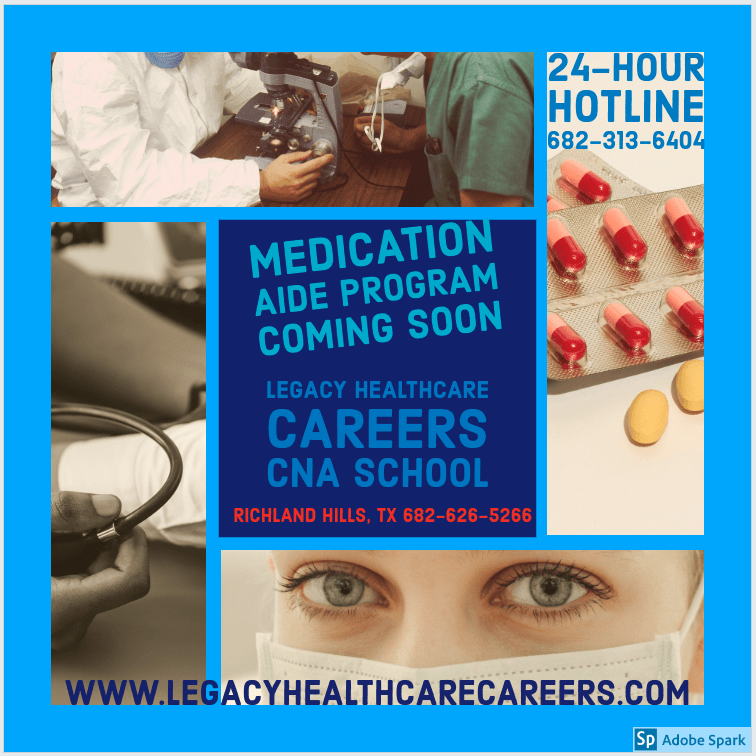
The staff of Legacy Healthcare Careers LLC CNA School is extremely pleased to announce the addition of a certified medication aide training program to the school’s high-quality nursing assistant course offerings. The addition of a certified medication aide program to the Fort Worth and Mid-Cities area is welcomed news to prospective students who would prefer to avoid an inconvenient commute to faraway cities for their career training needs.

The Fort Worth / Mid-Cities area certified medication aide training program is currently accepting new students for enrollments for the next class that begins August 20, 2019. Please call (682)626-5266 to enroll, or visit Legacy Healthcare Careers at 7505 Glenview Drive, Suite I, N. Richland Hills 76180 for more information.

The predominant purpose of the certified medication aide training program is to prepare individuals who are already employed as nursing assistants or direct care members of staff for higher-paying positions in the healthcare industry as certified medication aides in nursing homes, intermediate care facilities, group homes, assisted living, or skilled care nursing facilities.

The certified medication aide program has been formulated to teach students basic skills in the safe, prudent administration of non-parenteral medications. The ultimate goal of the certified medication aide program is to qualify graduates to administer medications in a safe manner and to assist licensed practical /vocational nurses (LPNs / LVNs) and/or professional registered nurses (RNs) in the important task of medication therapy.

The certified medication aide course of study in Texas has a minimum of 140 clock hours of targeted instruction. The 140 clock hours can be broken down into 100 classroom theory hours of instruction and training, 30 hours worth of return-demonstration lab coursework, and a minimum of 10 hours of hands-on clinical skills practicum at a healthcare facility under the direct supervision of a state-licensed RN instructor.

The medication aide training program is comprised of focused schooling in the following topics: basic review of bodily systems and the effects of various medications on these systems; medical terminology; principles of infection control; and drug classifications. All certified medication aide lessons at Legacy Healthcare Careers CNA School are taught by experienced registered nurse (RN) instructors.

Graduates of certified medication aide training programs in Texas must take and pass the written medication aide examination, which contains 100 multiple-choice questions that assess the test taker’s knowledge base regarding safe, accurate, prudent medication therapy (Texas Health and Human Services, n.d.).

Once the medication aide examination is passed, the candidate receives a practice permit as a certified medication aide (CMA). The CMA practice permit enables the nurse aide to secure employment as a certified medication aide at nursing homes, skilled nursing facilities, extended care facilities, intermediate care facilities, correctional facilities, assisted living settings and personal care group homes.

For any questions regarding the upcoming certified medication aide program that is now being offered at the Legacy Healthcare Careers CNA School campus near Fort Worth, please call (682)626-5266 or telephone the 24-hour hotline at (682)313-6404. The friendly members of staff will answer any questions you may have to the very best of their abilities.

https://youtu.be/MVtXTSrGaBY

Keep in mind that Legacy Healthcare Careers CNA School is also continuing to offer affordable, high-quality certified nursing assistant training classes with flexible schedules that enable prospective students to keep their jobs while obtaining occupational nurse aide training. Place a telephone call to (682)626-5266 to enroll in the certified nursing assistant program at Legacy Healthcare Careers.
Screenshot 2018-12-29 at 12.58.09 PM.png

RESOURCES

Texas Health and Human Services. (n.d.). Medication Aide Program FAQs. Retrieved from https://hhs.texas.gov/doing-business-hhs/licensing-credentialing-regulation/credentialing/medication-aide-program/medication-aide-program-faqs
Texas CNA Skills (Part Ten): General Guidelines for the CNA State Exam

selective focus photo of gray metal folding walker
Photo by rawpixel.com on Pexels.com

The following list is a set of general guidelines to help future nurse aide test takers know what to expect when taking the CNA state test.

  1. Always remember to speak with the patient to whom you are providing care, even if it might be a manikin. Effective communication entails introducing oneself and clearly explaining the procedural skills, which is all part of the skills section of the CNA state test.
  2. Equipment for the procedural skills will be available at the testing center. The nurse aide evaluator will give the test taker a list of all the equipment needed for the procedural skills that will need to be performed. It is the responsibility of the test taker to gather all the equipment. Thus, the test taker should gather and organize all needed equipment in a manner that is easiest for him or her.
  3. At the moment the skills competency section of the CNA state test begins, the test taker is allotted approximately 30 minutes to work through all of the assigned procedural skills.
  4. The test taker is required to wash his or her hands at the beginning of the simulated patient care scenario for the CNA state test. Hand-washing is the first procedural skill to be performed. The test taker is expected to perform hand hygiene by using hand sanitizer at other moments during the CNA state test as needed.
  5. The patient’s privacy and safety must be upheld during the entirety of the simulated patient care scenario. In addition, strict compliance with infection control techniques must be sustained during the entire scenario for the CNA state test.
  6. The test taker will need to physically work through each step associated with every procedural skill he or she has been assigned for the CNA state test. Once the skill is started, if an error is made, the test taker must say so and correct himself or herself. The test taker will be expected to complete the step that was missed.
  7. For the CNA state test, side rails are utilized only for safety with certain procedural skills performances. At other times, the side rails should be in the low position.
  8. Always keep in mind that the CNA state test should be reflective of the test taker’s provision of basic nursing care duties to a real patient and performance of direct hands-on care for that person.
  9. For the skills competency section of the CNA state test, the test taker can be safe to assume that he or she will be performing the skills on one patient and/or manikin and will not be alternating from resident to resident as a typical nursing assistant would in a nursing facility setting. The test taker must become proficient at all of the testable skills in addition to the opening procedures and closing steps for each skill.

REFERENCES

Lewis-Clark State College. (2013). Student Skills Packet. Retrieved from http://www.lcsc.edu/media/117278/2013-Student-Skills-Packet.pdf

Texas CNA Skills (Part Eight): What to Wear and How to Dress for the CNA State Test

person performing cpr on dummy
Photo by rawpixel.com on Pexels.com

The broad majority of states in the U.S. have enacted laws that require graduates of nurse aide training programs to pass the respective state-approved examination in order to secure occupational certification as a certified nursing assistant (CNA). Therefore, the CNA state test is extremely important to the future career prospects of countless nursing assistants.

Nonetheless, many nurse aide students remain blissfully unaware that a testing center dress code exists. Well, a dress code certainly does exist for the CNA state test, and more than one rationale for being dressed in a specific way at the testing center site has been presented. The rationales for the dress code have been listed below.

  1. Nurse aide test takers should anticipate the remote possibility of spending all day at the testing center. Therefore, all-day comfort is of the utmost importance.
  2. A nurse aide test taker might be asked to participate in a simulated patient care environment where he or she plays the role of a debilitated elderly patient for one or more other test takers who need to perform hands-on skills. Thus, nurse aide candidates will actually be performing their skills on each other during the skills evaluation section of the CNA state test.
  3. Nurse aide test takers should wear shoes with non-skid soles (bottoms) for safety reasons. The safety of all test-taking candidates needs to be upheld at the testing center.
  4. Any candidate who volunteers to play the role of the patient must wear flat slip-on non-skid closed toe shoes, loose pants or bottoms that are capable of being rolled up, and a loose tank top or loose-fitting shirt with sleeves that can be rolled up to the shoulders (Pearson Vue, 2018).

In general, test takers will never go wrong by dressing the part of an employed nursing assistant regardless of whether or not they opt to volunteer to pose as a patient. The following dress code is more of a basic set of guidelines for appropriate testing center clothing for the CNA state test. Keep in mind that Pearson Vue testing centers are the testing sites where all CNA state tests are conducted in the state of Texas. The following list contains generalities surrounding proper attire in regards to the Texas CNA state test, as well as testing sites in the majority of other states in the US.

  1. Wear closed-toe shoes with flat non-skid soles.
  2. Nurse aide test takers who do not volunteer to play the role of a patient should wear a medical uniform, scrub set, or casual attire. Clothing should be clean.
  3. Nurse aide test takers who choose to wear casual attire should wear jeans, pants, khakis or slacks to comply with the potential need for hands-on skills practice. Dresses and skirts are discouraged with the exception of religious reasons.
  4. Midriffs and abdominal areas should be covered.
  5. Nurse aide test takers should appear clean, groomed, and be free from strong body odor. Perfumes, body sprays and colognes are discouraged.
  6. Nurse aide test takers who wear white bottoms should wear proper underwear since patterned panties, briefs or boxer shorts might be seen through white material.
  7. Long hair should be worn back into a ponytail, bun, contained by a headband, or pinned.
  8. Fingernails should be kept short and trimmed.
  9. Nurse aide test takers must wear a wristwatch with a second hand.
  10. Limit / curtail the amount of jewelry worn to the testing center. The amount of jewelry the nurse aide test taker wears to the testing center site should be minimal.

image (4)

Be completely mindful that the CNA state test dress code is different in a handful of states in the US. For example, CNA state test sites in Arizona require all test-taking candidates to adhere to a very specific dress code, and those who do not comply will not be permitted to take the exam.

With regards to the CNA state test in Arizona, Headmaster LLP (2018) asserts that “SCRUBS (which consists of a scrubs top and scrub pants, scrub skirt (long, loose-fitting) or scrub dress (long, loose-fitting) and closed-toed, soft-soled shoes are the required dress code for testing. You will not be admitted for testing if you are not wearing scrub attire and the appropriate shoes. You will be considered a NO SHOW. You will have to pay for another exam date.”

Be sure to dress for success on the day of the CNA state test and beyond. The nurse aide testing site evaluator is the individual who will be observing for competency as the test taker performs the skills evaluation section of the state test. Dressing the part for the CNA state test can go a long way in presenting the image of a candidate who is fully competent, prepared, professional, and serious about his or her future career as a nursing assistant.

Readers have probably heard the olden adage that one never gets a second chance to make a first impression. The point is to present oneself to the testing site evaluator as a nurse aide who deserves to pass the CNA state test. A cleanly nurse aide candidate looks the part, whereas a test taker with 10 gold chains, a tight-fitting cropped top that exposes the torso and dirty blue jeans does not look professional.

https://youtu.be/fidScEV7qBk

REFERENCES

Headmaster, LLP. (2018). Arizona Nursing Assistant Candidate Handbook. Retrieved from http://hdmaster.com/testing/cnatesting/arizona/azformpages/azforms/AZCandidateHandbook%202.1.18.pdf

Pearson Vue. (2018). Texas Nurse Aide Candidate Handbook. Retrieved from https://home.pearsonvue.com/getattachment/73a0c524-4cbe-401a-aa5c-fe1ebf4e2517/Texas


Nursing Career Ladder in the United States (Part Three): the Registered Nurse (RN)

healthy clinic doctor health
Photo by Pixabay on Pexels.com

This post is intended to be the third in a four-part installment series that aims to illuminate the dynamic, ever-evolving nursing career ladder in the United States.

The first post in this particular series discussed certified nursing assistants, known as CNAs for short. The second post in this series elaborated on the unique importance of licensed practical nurses (LPNs), also known as licensed vocational nurses (LVNs) in the states of California and Texas. This post will shed some light on registered nurses.

A professional registered nurse, known as an RN for short, is a multi-faceted healthcare professional who is entrusted with the delivery of both direct and indirect nursing care duties and responsibilities. During the course of providing nursing care, the RN observes, assesses and records objective signs and subjective symptoms that patients experience.

RNs document additional findings such as reactions to treatments, progress and patient outcomes. The RN’s keen observations and clear documentation serve as the the hardcore foundation for the planning of patient care, initiation of interventions, and overall evaluation of the patient care that is being provided.

RNs routinely report changes in patients’ conditions to the physician and carry out physicians’ orders as indicated. Moreover, RNs promptly respond to subtle and overt changes in condition to prevent further deterioration of patients’ health statuses. RNs work work in bedside or clinical settings may perform a wide repertoire of procedural skills such as medication administration, complex wound care, respiratory ventilator management, and so forth.

RNs plan all aspects of the care of their patients. In fact, RNs continually formulate and revise nursing plans of care. RNs also teach and educate patients and families on the provision of appropriate care techniques. They also help different individuals, groups and populations to sustain and/or improve their various health statuses.

Professional registered nursing practice regularly draws upon an amazingly large fund of knowledge in order for the nurse to deliver appropriate assessment, planning, nursing diagnoses, intervention and evaluation. These actions, collectively referred to as the nursing process, are executed in a timely fashion to promote patients’ health statuses, prevent devastating illnesses and help clients manage their varied disease processes.

RNs can be found working in varied healthcare settings such as hospitals, extended care facilities, hospices, clinics, doctors offices, home health companies, colleges, universities, occupational health centers, private duty cases, and psychiatric facilities. RNs also work for insurance companies, research firms, governmental agencies, jails, prisons, public health centers, parishes, pharmaceutical corporations, and an array of other workplace settings.

While state laws tend to dictate nursing’s breadth and scope of practice, it is often the specific needs of the patient load on a particular day that determine the RN’s duties for that day. To become an RN, a prospective candidate must graduate from a state-approved nursing program at a community college, diploma school of nursing, trade school, technical college, or university. The graduate must also pass a national exam to secure state licensure as a registered nurse.

Many certified nursing assistants (CNAs) continue their education to become LPNs and/or RNs, thereby ascending the nursing career ladder. Legacy Healthcare Careers offers four-week CNA classes in the Dallas/Fort Worth area that are affordable and will fit in with prospective pupils’ budgets and lifestyles. Call (682)626-5266 or the 24-hour hotline at (682)313-6404 to enroll at our Mid-Cities / HEB area location.

Be sure to look for the fourth and final post in this information-packed four-part series on the dynamic nursing career ladder in the United States. Also, do not forget to place a quick telephone call to Legacy Healthcare Careers at (682)626-5266 or the 24-hour hotline at (682)313-6404 to enroll in fast-track certified nursing assistant (CNA) training coursework.

Where Can I Train to Become a Certified Nursing Assistant (CNA) in the Dallas-Fort Worth Area?

computer desk laptop stethoscope
Photo by Negative Space on Pexels.com

When the topic of nurse aide training is brought to the forefront, a number of different options are available to a prospective student located in the Dallas-Fort Worth area of Texas who would like to train to become a certified nursing assistant (CNA). CNAs are also known as nurses aides, patient care assistants, nursing aides, nursing assistants, and orderlies.

First of all, multiple local community colleges provide high-quality nursing assistant training in the Dallas-Fort Worth metroplex. Some of the local community college programs that deliver nursing assistant training programs include Brookhaven College, Tarrant County College (TCC), North Central Texas College (NCTC), Hill College, Trinity Valley Community College (TVCC), El Centro College, Weatherford College, and Navarro College.

Community college CNA programs are wonderful options for several reasons. First and foremost, community college CNA programs tend to be very affordable. Second of all, community college CNA programs simultaneously provide excellent nurse aide training, academic instruction and practical hands-on preparation to pupils.

Nonetheless, a major drawback associated with typical community college CNA programs is the fact that the training can sometimes take eight (8) weeks or longer to complete. Not everyone wants to spend half a semester in the nurse aide training program. After all, time is of the essence.

Another potential drawback is that these community college CNA programs frequently have inflexible admissions requirements that may exclude many wonderful prospective students. Normally, these programs attract far more interested applicants than can be reasonably admitted while not having enough seats available to everyone who would like to attend CNA school. In other words, some prospective students are turned away due to seats filling quickly at community college CNA programs.

image (3)

Legacy Healthcare Careers LLC is a school that provides very affordable CNA classes in the heart of the Dallas-Fort Worth metroplex. The CNA lessons are approved to operate by both the state Department on Aging and Disability Services (DADS) and the Texas Workforce Commission (TWC).

Tuition is for the certified nursing assistant program is $850 and the program is only two weeks long from start to graduation. Also, Legacy Healthcare Careers offers a fast track one-week CNA program. Moreover, a high school diploma or general education diploma (GED) is not needed to enroll.

In addition, Legacy Healthcare Careers provides theoretical and clinical practicum instruction to students that is based on the Texas-approved state curriculum. Moreover, the one-week and two-week nursing assistant training programs can potentially open the doors to a dynamic allied healthcare career as a nursing assistant in LESS THAN ONE WEEK!

Feel free to call Legacy Healthcare Careers CNA School at (682)626-5266 or telephone the 24-hour hotline at (682)313-6404 for more information regarding enrollment. Classes are starting soon.

https://youtu.be/xRWYLBzBUYE

11-Day CNA Program in the Dallas-Fort Worth Metroplex Area

people coffee meeting team
Photo by Startup Stock Photos on Pexels.com

Legacy Healthcare Careers LLC is a healthcare career school that offers high quality daytime and evening certified nursing assistant programs, phlebotomy classes and medical assistant training in the Dallas/ Fort Worth Metroplex area. Tuition for the career training programs is very affordable, and flexible payment plans are available to fit into most prospective students’ budgets and lifestyles.

In addition, Legacy Healthcare Careers is home to the 11-day CNA program. Students who have the motivation to attend school for eleven long days in a row could graduate as nursing assistants. Call (682)626-5266 for more information on Legacy Healthcare Careers’ eleven (11) day CNA program, or visit 7505 Glenview Drive, Suite I, North Richland Hills TX 76180 for a tour.

Legacy Healthcare Careers offers quality, affordable CNA lessons for a wide service area in the DFW Metroplex that can easily accommodate prospective students who reside in Fort Worth and its suburbs. Students have commuted from Azle, Haslet, Lake Worth, Saginaw, Pelican Bay, Grapevine, Colleyville, Haltom City, Hurst, North Richland Hills, Bedford, Watauga and the Mid-Cities HEB area.

Most of the day, evening and weekend certified nursing assistant programs at Legacy Healthcare Careers are only a few weeks in length, and all CNA lessons are taught by experienced registered nurses (RNs). The fast track nurse aide programs are designed to enable students to jump-start their legacies and brand new careers as nursing assistants sooner rather than later. After all, time is of the essence for most people.

In addition, various Fort Worth area cities and suburbs such as Crowley, Coppell, Burleson, Keller, Everman, Arlington, Euless, Forest Hill, Kennedale, Mansfield, Irving, Grand Prairie, White Settlement, Midlothian, Meadowbrook, River Oaks, Benbrook, River Oaks, Weatherford, Roanoke, Aledo, Dallas, Springtown, and other local surrounding cities are in the service area for Legacy Healthcare Careers CNA School.

Legacy Healthcare Careers CNA school has a conveniently located Mid-Cities HEB area campus that is located smack dab in the middle of the Dallas/ Fort Worth Metroplex. The Legacy Healthcare Careers campus location is convenient to prospective pupils who live in Fort Worth, Arlington, Dallas, the HEB area and surrounding cities, towns and suburbs.

The tuition for the CNA programs is really affordable, competitively priced, and an amazing deal. Legacy Healthcare Careers offers a wide variety of different class schedules and nursing assistant courses that will conveniently fit into the busy lifestyles and schedules of prospective students.

16 years old is the minimum age to enroll with parental consent. Also, no high school diploma or GED is needed to enroll as long as applicants can prove they have completed at least an eighth (8th) grade education by providing a middle school diploma, high school transcripts, high school diploma or college transcripts.

All courses are taught by experienced RNs, which is not the case at other CNA schools in the Dallas/ Fort Worth area. Call the Legacy Healthcare Careers campus line at (682)626-5266 or the school’s 24-hour hotline at (682)313-6404 to ask about scheduling a tour of the school and enrolling in nursing assistant lessons today. Jump-start your legacy right now in the present day to provide a good investment in your future career pathway.

Also visit the school’s website, www.LegacyHealthcareCareers.com or the school’s blog at www.LegacyHealthcareCareers.org for additional information and resources on careers in the nursing profession.

https://youtu.be/wB1CjU-jQR8