
Healthcare Career Spotlight: the Chiropractic Assistant

person holding x ray film
Photo by rawpixel.com on Pexels.com

A chiropractic assistant, also known as a chiropractic medical assistant, is a multi skilled allied healthcare worker who performs a variety of administrative and clinical tasks to facilitate the routine day to day operations of chiropractic clinics and practices. Chiropractic assistants review patients’ customized treatment plans in order to render care and deliver specific healthcare services.

The primary function of the chiropractic assistant is to assist chiropractors in the provision of care to patients in outpatient healthcare settings such as specialty clinics, pain management practices, and chiropractic doctors’ offices. A chiropractic assistant provides hands-on patient care. In addition, chiropractic assistants complete a number of clerical tasks to ensure smooth functioning of chiropractic practices.

Chiropractic assistants perform clinical duties such as checking patients into the clinic or practice setting, rooming patients, measuring and charting body weight and height, obtaining health histories, and helping patients complete questionnaires and other forms as needed by the chiropractor. They observe patients and promptly report any unusual reactions to treatments and/or changes in patient status to the chiropractor.

In addition to the previously mentioned duties, chiropractic assistants obtain subjective health data including vital signs (blood pressure, temperature, heart rate, respiratory rate) for the chiropractor’s use in physical examinations and treatment plans. Chiropractic assistants also assist in other hands-on patient care tasks such as physiotherapy treatments, exercises and hot and cold therapies.

Moreover, chiropractic assistants carry out administrative front office tasks such as greeting people at the reception desk, confirming payer sources and medical insurance coverage, scheduling appointments, billing, filing paperwork, answering telephones, checking emails, navigating computer software systems, communicating with supply vendors, and maintaining the cleanly appearance of the waiting area.

The overwhelming majority of chiropractic assistants can be found working in places of employment such as multi specialty practices, chiropractor offices, pain management clinics, and personal injury chiropractic clinics. Chiropractic assistants work alongside chiropractors, x-ray technicians (radiographers), and other types of healthcare providers and allied health professionals.

Ideally, the chiropractic assistant needs to have superb communication skills and the ability to relate to patients from a variety of different backgrounds. They should possess a cordial personality and be knowledgeable about the ethical aspects of their role, including the principles of veracity (truthfulness) and confidentiality (the obligation to keep protected health information private).

In addition, a chiropractic assistant should know how to utilize appropriate body mechanics and have some physical strength due to the continual bending, frequent lifting, occasional twisting, and lengthy periods of time they may spend on their feet during a typical day at the workplace. They are expected to work under minimal supervision, make many decisions independently and be problem solvers.

Safety is fundamental in the role of a chiropractic assistant. They must handle patients with extreme care to prevent and avert avoidable injuries to themselves and the patients to whom they render direct care. Furthermore, chiropractic assistants always need to comply with standard precautions and infection preventative principles to ensure their patients remain safe.

To become a chiropractic assistant, an individual should be a high school graduate or GED recipient. Earning a diploma, certificate or associate degree in medical assisting can add legitimacy to a career as a chiropractic assistant and make the job search much easier. After attaining a diploma or degree in medical assisting, a person should take the extra step of obtaining national certification as a certified medical assistant.

Job market demand for chiropractic assistants is expected to be robust well into the future. Per the United States Bureau of Labor Statistics, which places chiropractic assistants into the Medical Assistants employment category, the projected job growth rate for this allied healthcare professional role is an estimated 29 percent through the year 2026. This projected growth rate greatly exceeds the average of all other kinds of jobs.

The massive increase in population of the aging Baby Boomer population will continue to fuel the high demand for preventive and holistic healthcare services, which are often provided by chiropractors. Because of these reasons, chiropractors are expected to hire a larger number of chiropractic assistants to complete routinized administrative and clinical duties, enabling chiropractors to attend to more patients.

Legacy Healthcare Careers delivers affordable, quality, judgment-free healthcare job training to students in the Dallas /Fort Worth Metroplex area of Texas. Please call Legacy Healthcare Careers at (682)626-5266 or (682)313-6404 to enroll in one of our healthcare occupational training programs. Call today. Classes start very soon.

Scholastic Spotlight: The Clinical Externship Defined

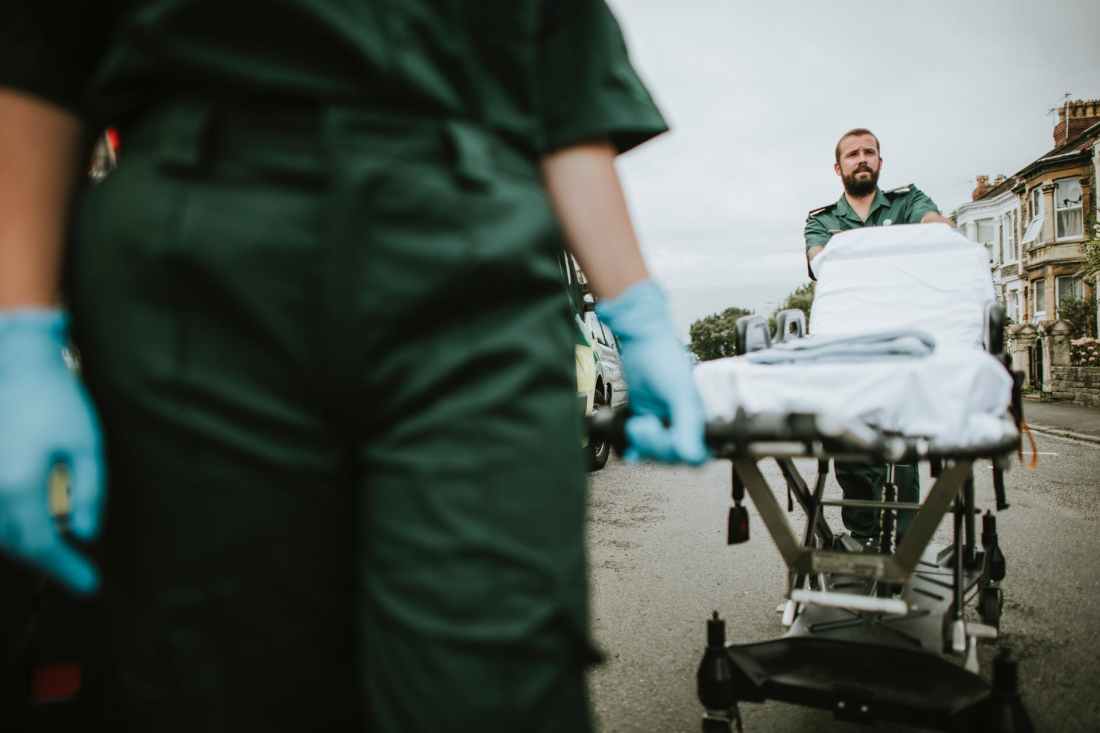
man pushing hospital bed
Photo by rawpixel.com on Pexels.com

So, what exactly is an externship? Well, a clinical externship is an unpaid learning opportunity for students in schools of nursing, nurse aide (CNA) training programs, medical assisting training programs and other types of allied healthcare courses to facilitate full immersion in acquisition of hands-on practical skills in a particular sphere of interest.

Essentially, the clinical externship is the educational phase of most health science training programs that enables pupils to shadow more experienced allied healthcare workers in the specific career pathway that is being pursued. For instance, a nurse aide training program clinical externship would entail students shadowing more experienced nursing assistants as they provide basic patient care duties at a healthcare center.

During the clinical externship, the allied healthcare student works alongside more experienced healthcare workers in a workplace setting in the field or discipline of study. The student provides hands-on care to real clients under the supervision of a clinical instructor and is being evaluated for their performance the entire time. The student jumps in and assists clients with their patient care needs in a hands-on manner.

What can allied healthcare students look forward to during the clinical externship phase of their training? It can really differ depending on the specific type of training program. Each externship has its similarities and differences; however, a few commonalities do exist. The following list contains some potentially useful pearls of wisdom regarding clinical externships to assist in easing the student’s fears of the unknown.

  • The student’s clinical externship site or setting will depend on the training program he or she is enrolled in. For example, a medical assisting trainee might be assigned to a clinic or doctors office, whereas a nurse aide student will most likely be sent to a skilled nursing facility.
  • To make the most of the externship phase and maximize the learning experience, students should ask questions, be as helpful as humanly possible, and offer to provide assistance to the allied healthcare professionals at the clinical site. This is the student’s chance to shine and build a solid reputation in his or her future profession.
  • Students should always be ready to adhere to the predetermined rules of the clinical site. These rules might include standard workplace fare such as dress codes, hours of operation, social media usage policies, meal breaks, standards for professional conduct, proper chains of command, and so forth.
  • The clinical externship provides an amazing chance to learn new skills, as well as the opportunity to blossom both professionally and personally. It would be wise if the student adopts the stance that constructive criticism can pave the way for streamlined opportunities for improvement.
  • Keep in mind that the clinical instructor who supervises students at the clinical externship most likely has a vast amount of enriching experiences from school and work as a foundation to teach. Do not forget to utilize the clinical instructor as an educational resource. After all, they are there to help students acquire practical skills under supervision.
  • Clinical externships usually last anywhere from few days to several weeks depending on the requirements of the training program. In addition, the school’s administrative staff selects the clinical site location due to pre-existing contracts with healthcare facilities in the community where the school is located.
  • Students are usually graded and/or evaluated on their overall performance during their time at the clinical externship. In essence, the clinical externship is the student’s opportunity to thrive, bring positive attention toward oneself, and absorb mountains of new information in a practical manner. In other words, the clinical externship is full of awesome opportunities that should not go to waste.
  • As a general rule of thumb, allied healthcare students who are attending a clinical externship will not be paid for their time because it is a requirement for completion of the school’s training program. Time spent at the clinical externship site should be seen as schooling, not employment.

A clinical externship is a very important aspect of healthcare occupational training programs that students undergo in order to graduate and move on to thriving careers in the medical field. A clinical externship permits students to put multiple skills to use that are absolutely imperative for securing gainful employment in the healthcare field.

Call Legacy Healthcare Careers CNA School at (682)626-5266 to obtain a rewarding career in the healthcare industry as a nursing assistant. The training programs offered by Legacy Healthcare Careers all involve clinical externships at local healthcare centers in the Dallas/Fort Worth area of Texas.

Partial Tuition Scholarship Money to Help Pay For CNA Classes

person using stethoscope on bear plush toy
Photo by rawpixel.com on Pexels.com

The following news is specifically directed toward any prospective students in the Dallas-Fort Worth Metroplex area of Texas who would like to receive some monetary assistance by way of a partial tuition scholarship to cover the costs of attending CNA (certified nursing assistant) classes. The Health Occupations Scholarship Award helps prospective pupils to attend a CNA training program by partially covering some of the expenses.

For certain students, the Health Occupations Scholarship Award could provide helpful financial assistance that they should surely look up further. Offered by Legacy Healthcare Careers Nursing Assistant School in the Mid Cities region of DFW, this particular scholarship award can be granted to people who are planning to attend a healthcare training program at this Dallas/Fort Worth area institution.

To be eligible, all candidates need to be 18 years of age or older. Ideally, all candidates should have a desire to either join the medical field or healthcare industry, or at least have plans to further their careers in a healthcare vocation. All winners of the Health Occupations Scholarship Award will receive one partial tuition scholarship that also covers the costs of needed books, fees and other pertinent scholastic supplies.

The Health Occupations Scholarship Award has been specifically designated for students who have intentions to enroll in nursing assistant training courses or another type of healthcare occupational training program at Legacy Healthcare Careers CNA School. Scholarship applicants are allowed to enroll in healthcare training coursework at Legacy Healthcare Careers on either a full time or part time status.

Students who are potentially eligible for the scholarship award must also exhibit or express their dedication to the medical field and/or healthcare industry by submitting a short essay as part of their application package. Students must have a strong work ethic, prove a verifiable work history, and sign an enrollment agreement in person to attend healthcare training classes at Legacy Healthcare Careers.

Completion of an application for the Health Occupations Scholarship Award is a somewhat simple process to follow. To apply for the scholarship award, visit the Legacy Healthcare Careers official school website (www.LegacyHealthcareCareers.com) and continue to scroll down several pages in order find the correct icon to click to submit a scholarship application.

Potential students are also able to gain immediate access to the application form for the scholarship application if they click on the following link that appears below. Students can also feel free to simply copy and paste the following link into any web browser of their choice to retrieve and access the scholarship application form:

http://www.123formbuilder.com/form-4595340/scholarship-application

The Health Occupations Scholarship awards are issued in the amounts of $250, $100 and $50. Moreover, three (3) scholarship awards are to be issued to winning students on a monthly basis. The scholarship application requires candidates to prepare a short essay of approximately three to seven sentences that provides one or more good reasons for wanting to join the ranks of the healthcare industry or medical field.

It is mandatory that prospective pupils who submit an application package for a scholarship award follow up with a face to face meeting with the Legacy Healthcare Careers director of education or program administrator for a school tour. Only students and prospective students who sign enrollment agreements with Legacy Healthcare Careers will receive one of the partial tuition scholarship awards.

Each scholarship award winner will be chosen on the overall strength of the application package including several factors. These factors include quality, perceived authenticity of the prospective pupil’s essay submission, and the required follow-up visit with a school official at Legacy Healthcare Careers. Scholarship winners will be made aware of their award via telephone calls or face to face during a tour with the director of education.

It must be repeated that the Health Occupations Scholarship Award is only being made available to individuals who sign an enrollment agreement to go to nurse aide training classes or one of the health occupational training programs offered at Legacy Healthcare Careers. Place a call to the school’s 24-hour enrollment hotline number at (682)313-6404 if there are any other questions, concerns, comments or info that need to be addressed.

Do you have the desire to change your life? Wouldn’t you prefer a career instead of just a job? Have you been thinking about acquiring a fulfilling career in the healthcare field? Do you really have what it takes to follow through and make the changes in your life to obtain the new career that you want?

Well, a position as a certified nursing assistant (CNA) is a wondrous way to get one’s foot into the exciting doors of the medical field. Legacy Healthcare Careers is a local school in the Dallas-Fort Worth area of Texas that offers several quick, quality CNA programs. Call us at (682)626-5266 or place a call to our 24-hour hotline at (682)313-6404 if more information is needed.

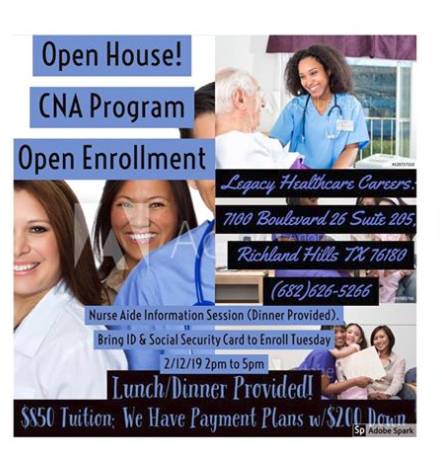
CNA School Open Enrollment Event: February 12, 2019

Screenshot 2019-02-08 at 6.55.02 PM

The time has come to welcome prospective nurse aide students to Legacy Healthcare Careers CNA School’s Open House /Open Enrollment event located at 7100 Boulevard 26, Suite 205, Richland Hills, Texas 76180. Food will be provided on a first come /first serve basis. This event takes place on Tuesday February 12, 2019 between 2:00pm and 5:00pm.

The staff of Legacy Healthcare Careers will be offering helpful information on healthcare careers, immediate assistance with enrollment in nurse aide training classes on the spot, and tours of the school. Please bring a photo ID, social security card, and a $200 down payment to enroll.

The next CNA classes at this Fort Worth area school will be starting on Monday February 18, 2019 as well as Monday February 25, 2019. Legacy Healthcare Careers offers an affordable 7-day (1-week) CNA program. In addition, the school offers a 2-week CNA program and a 3-week CNA program.

Please RSVP via e-mail to Legacy Healthcare Careers at LegacyHealthcareCareers@ Yahoo.com by Tuesday February 12 to indicate whether you can attend, or feel free to telephone the school’s 24-hour enrollment hotline at (682)313-6404 to confirm your attendance at this open house event.

The staff of Legacy Healthcare Careers hopes to see you at this special open enrollment event. The school owes its success to people like you, so please graciously accept our sincere gratitude for your support. A career in the healthcare industry can be fulfilling and transforming. In addition, a healthcare career can boost your value in the local employment value, so jump-start your legacy today.

Texas CNA Skills (Part Thirteen): Resources to Help Prepare for the CNA State Test

smiling woman holding red cutout heart
Photo by rawpixel.com on Pexels.com

The National Nurse Aide Assessment Program (NNAAP), also known as the CNA state test, must be passed by any nurse aide who wants to attain state certification as a CNA. In addition, nurse aides who plan to pass the CNA state test on the very first attempt would be wise to utilize all of the resources they can possibly get their hands on. It also helps that many of the existing resources are completely free!

Fortunately, there are numerous resources out there to help students conquer the state test successfully. Preparation is the key, so the following resources will prove useful only if the student uses them and does not wait until the last minute to cram them in and study during the final hour. In fact, studying for the CNA state test should really be an ongoing process in which small amounts of material are covered each day.

Even though a mountain of testing information exists throughout the deepest crevices of the world wide web, a few of the resources might be terribly outdated or not all that informative. Therefore, a list of more relevant resources have been compiled and listed below to help nurse aide students prepare for the CNA state test. Take a deep breath, relax, prepare, and enjoy your future nursing assistant career!

  • Other Schools’ CNA Program Websites: Many CNA programs publish their lecture notes, study guides, PowerPoint presentations, online lessons and other learning materials for free. Click here to get to a series of excellent PowerPoint presentations on CNA lessons from the Kings County Office of Education.
  • Texas Curriculum for Nurse Aides in Long Term Care Facilities: This is the official nurse aide curriculum that has been approved for use by the state of Texas. In fact, the theory and skills contained within this curricula are used to formulate the questions and skills scenarios on the Texas CNA state test. Click here to get to the Texas curriculum.
  • Illinois State Nursing Exam Practice Test: This is a sample CNA state test that is being offered completely online through the Southern Illinois University website. This exam enables the user to select the number of questions; moreover, it automatically checks the submitted answers for correctness. Unlike the real CNA state test, no time limit have been imposed on this practice test.
  • Study Guide Books: There happens to be a myriad of CNA study guides for sale on websites such as Amazon, Ebay and Barnes & Noble that are designed to help test takers prepare for the written portion of the CNA state test. Purchasing one of these study guides might be a wise investment.
  • National Nurse Aide Assessment Program (NNAAP) Practice Exam: This practice test contains a number of questions that are extremely similar to ones that will be seen on the written section of the CNA state test. Therefore, it would be a good idea to take this practice exam, review the answers, and study the rationales for all the answers. Click here to get to the NNAAP Practice Exam.
  • Bureau of Labor Statistics (BLS): The BLS website, which happens to be updated and maintained by the United States Department of Labor on a regular basis, contains the most up-to-date statistics on the nursing assistant role. The BLS site has info such as routine nurse aide duties, work environment, average pay rates, and projected job outlook. Click here to get to the BLS nursing assistant web page.
  • Your CNA School: Do not forget to utilize the CNA school that you attended because the instructors can serve as knowledgeable resources. A reputable CNA program will be staffed with instructors who want students to succeed, so it is in the best interests of the school’s staff to assist graduates in preparing for the state test.

Scholarships to Attend CNA School: the Health Occupations Scholarship Award

empty theater seats
Photo by Jaime Fernández on Pexels.com

The following announcement is intended for any persons in the Dallas-Fort Worth Metroplex area of Texas who are seeking financial help in the form of a partial tuition scholarship to attend a certified nursing assistant (CNA) training program. The Health Occupations Scholarship Award is definitely worth exploring further.

Provided by Legacy Healthcare Careers CNA School, this scholarship fund has been made available to prospective students who are pursuing occupational healthcare training at this Dallas/Fort Worth area school. Applicants must be at least 18 years of age and should have a desire to pursue a career in the healthcare field. Award winners receive partial-tuition scholarships including books, supplies and fees.

The scholarship awards are specifically for students who plan to enroll in nurse aide or other healthcare occupational training classes at Legacy Healthcare Careers. Prospective students may be enrolled in courses on a full time or part time basis. Students should also display dedication to the healthcare field and have a solid work ethic. Students must be or plan to be attending school at Legacy Healthcare Careers.

Submitting an application for scholarship award money is a fairly straightforward process. To apply, visit the school’s website (www.LegacyHealthcareCareers.com) and scroll down to submit a scholarship application. In addition, the scholarship application can be accessed directly by clicking or copying and pasting the following link into a web browser: http://www.123formbuilder.com/form-4595340/scholarship-application

The award amounts are $250, $100 and $50. Three scholarship awards will be granted every month. During the application process, students will be required to write a short one-paragraph essay that contains a detailed explanation on their reasons for entering the healthcare field. Prospective students who apply for a scholarship must also follow up by meeting with the school’s director for a tour of the school.

Scholarship winners will be selected on the basis and quality of the essay submissions. Winners will be notified via phone. This scholarship is only available to prospective students who enroll in one of Legacy Healthcare Careers’ health occupational training programs. Call (682)313-6404 for questions or any additional information.

Are you considering a career in the healthcare industry? Do you have the follow-through and motivation to do it? A career as a certified nursing assistant (CNA) is an amazing point of entry into the healthcare sector. A healthcare career as a CNA provides the ultimate foundation to almost any individual’s future in the health sciences. 

Legacy Healthcare Careers delivers several high quality CNA programs. In addition, the school intends to offer state-approved medication aide training in the spring of 2019 at our Fort Worth Mid-Cities area campus. Call (682)626-5266 or the 24-hour hotline at (682)313-6404 for additional information. This is a golden opportunity. Do not pass it up.

Completely Online CNA Programs: A Word to the Wise

screenshot 2019-01-29 at 9.49.35 am

Let’s address this complicated issue head-on: modern day life is ridiculously busy! Most busy adults are juggling employment, family time, a social life and other aspects of their lives to strike some sort of balance. These time-consuming facets of life do not leave all that much time to attend school full-time, especially in a classroom setting.

After all, who has time to sit in a classroom for several hours per day? After working hard for eight to twelve hours all day long, does any sane person really want to spend the rest of the evening or all weekend long in a classroom setting? Most people would rather be at home where they can wind down, chill out, relax, eat a home-cooked meal or spend a few precious hours with the ones they love the most.

However, many people are unsatisfied with their current jobs. Some people may even hate their jobs with a passion! Therefore, the thought of returning to school to prepare for a career change has often crossed their minds. While these folks may mentally dance with the idea of going back to school, the reality of it often involves giving up multiple evenings or weekends to spend time in a classroom. Again, who really has time for that?

Ah, but there appears to be a solution that can be integrated into peoples’ busy lifestyles: online classes! In addition, many people want to enter the nursing profession due to the potential of steady pay and abundant job opportunities, so they search the internet for online healthcare career programs that can be completed in the comfort of one’s home.

Here is a word to the wise. Regardless of any fancy advertisements you may have seen, you cannot become a nurse completely online. You cannot become a CNA completely online. In fact, no state board of nursing in existence will allow students to become nurses totally online for one very simple reason: no one can truly learn to provide hands-on nursing care to patients without actually touching any patients.

The large number of online nursing degree programs that are advertised on the internet have been designed for people who are already licensed nurses (LPN or RN). These online nursing programs allow licensed nurses to pursue higher education and earn additional nursing degrees from a college or university while keeping their full time jobs.

For instance, an RN with an associates degree can complete an online bachelor of science degree in nursing (BSN). However, she first had to complete her associates of science degree in nursing (ASN) face to face in a class setting before qualifying for admission to the online BSN program. All state boards of nursing require nursing students to amass a certain number of classroom and clinical practicum hours in order to graduate.

Think about it. Would you want a nurse with no patient care experience whatsoever to take care of you or your loved ones? A nurse whose only schooling was online classes never received hands-on training in patient care. All nurses must complete a clinical practicum externship that entails spending many hours in hospitals, nursing homes and other healthcare settings where they learn to provide hands-on care to real patients.

It is a similar situation with nursing assistant training. For instance, the state of Texas requires prospective nurse aides to complete a 100-hour CNA program that is comprised of 60 class and return demonstration lab hours as well as 40 clinical externship hours. This clinical externship occurs in a healthcare facility where students deliver hands-on care to patients. This is how nurse aide students learn to become CNAs.

In a nutshell, completely online CNA programs do not exist, at least in the state of Texas where 100 hours of face to face instruction are required. If something seems too good to be true, it probably is. The goal of this piece is to help readers and prevent them from being scammed by unscrupulous online businesses that claim to offer online CNA school. If this posting helps just one student out there, it will have been worth it to us.

Do you have the motivation to change your career? The 7-day CNA program at Legacy Healthcare Careers offers state-approved career training to become a nursing assistant in approximately one week. Call (682)626-5266 to enroll at Legacy Healthcare Careers CNA School now! Classes start soon.

Healthcare Career Spotlight: the Personal Care Assistant

woman holding hands
Photo by Pixabay on Pexels.com

Personal care assistants, also known as direct care workers, personal care attendants, direct care staff, home care aides, paid caregivers, healthcare assistants, carers, home health or personal care aides, are allied healthcare workers who provide hands-on assistance to clients who are not able to help themselves.

The clients of personal care assistants are often unable to help themselves due to a wide variety of reasons that might include lengthy illness, cognitive or mental impairment, acute injury, physical disability, advanced age, weakness or fragility. Other clients may be rendered unable to care for themselves due to intellectual and developmental disabilities, limited mobility, paralysis, debility or congenital handicaps.

Personal care assistants typically work in the home setting and assist their clients with various activities of daily living, such as showering, bathing, toileting, feeding, grooming, and taking medications. Personal care assistants may also be responsible for other tasks such as meal preparation, light housekeeping duties, and companionship.

In addition to the aforementioned tasks, personal care assistants might also assist their clients in the instrumental activities of daily living that help ensure households run smoothly. These instrumental activities can include the provision or arrangement of transportation, physicians’ appointments, ensuring clients take their medications, and other duties. Personal care assistants often serve as companions to their clients.

Most personal care assistants are employed by home care agencies to report to the homes of clients, while some personal care assistants are hired directly into private duty cases by clients or family members of the client. Likewise, some personal care assistants are employed by personal care group homes, assisted living facilities and independent living complexes where they often report directly or indirectly to a licensed nurse.

The typical personal care assistant tends to work long hours. Their role can be physically demanding on occasion due to lifting requirements and extended periods of time spent in a standing position. Nonetheless, this healthcare career can be very fulfilling due to the profound sense of purpose many workers derive after helping people who cannot help themselves. Providing companionship to clients can be invigorating.

The majority of personal care assistants have earned a minimum of a high school diploma or general education diploma (GED) certificate, but this level of education is not required by all employers. Sometimes the training for the personal care assistant role is done on the job by licensed nurses or other assistants with more experience.

The on-the-job training typically provided to personal care assistants is comprised of safety information, response to common emergency issues, and other duties specific to the home or employer. Additional training topics may include proper body mechanics, self-care techniques, and ways to deal with difficult client behaviors.

A number of states may require personal care assistants to complete more formalized occupational training from an adult education center, vocational school, nurse aide training academy, community college program or other home health entity. Also, certification is mandated for all personal care assistants who work for companies that receive reimbursements and payments from the Medicare or Medicaid programs.

A healthcare career as a personal care assistant opens the doors to wonderful attributes such as steady income and job security. The Baby Boomer generation is aging and becoming elderly; therefore, personal care assistant job openings will increase at a speedy pace in the foreseeable future. Personal care assistant job openings are projected to increase by 69 percent, much faster than the average of all other occupations.


Texas CNA Skills (Part Twelve): Understand the Patient Care Scenario!

pexels-photo-921778.jpeg
Photo by rawpixel.com on Pexels.com

The CNA state test consists of  a written section as well as a hands-on clinical skills portion. The clinical skills section of the CNA state exam test is comprised of multiple procedural skills interwoven into a simulated patient care scenario that has been formulated to resemble situations nursing assistants aides normally encounter during the course of a shift at the workplace.

The clinical skills section of the CNA state test is administered in a simulated caregiving situation that will look almost exactly like the patient care environment in which most nursing assistants are expected to function. Unless specified otherwise, all the equipment and supplies a test taker needs during the clinical skills section of the CNA state test will be supplied by the testing site.

The skills section of the CNA state test will be designed to seem as realistic as possible. Also, the test taker will perform the hand-washing skill the on first instance it is needed in the test. However, after the first hand-washing demonstration, all other moments that require hand hygiene will only need to be verbalized. For instance, after performing foot care, the test taker would verbalize, “Now I would wash my hands.”

The patient care scenario will be typed on a sheet of paper or index card and handed to the test taker by the testing site evaluator. In most cases the testing site evaluator will read the scenario instructions to the test taker before the clinical skills section of the CNA state test is slated to begin.

The ‘patient’ who participates in the simulated patient care scenario is usually another test taker who has graciously volunteered to step into that role. In other words, test takers will perform hands-on skills on each other during the CNA state test. Test takers who volunteer to pose as a patient must adhere to a predetermined dress code.

However, instances do arise where performance of a procedural skill on a mannequin would be far more appropriate. For instance, if the scenario card involves an intimate skill such as perineal care or urinary catheter care, the test taker will demonstrate it on a mannequin rather than another person.

The following is an example of a simulated patient care scenario that is similar to what one would receive during the skills section of the CNA state test.

Sample Scenario 

Ms. Hernandez: Hand-washing / Manual Blood Pressure / Give Modified Bed Bath / Mouth Care / Position on Side

Ms. Hernandez is a 65-year-old long term resident of Curry Hills Nursing & Rehab Center who has hypertension and major depressive disorder. She has refused showers for the third day in a row due to her depressed mood. When you enter Ms. Hernandez’s room, you find her laying in bed. She is wearing a hospital gown, bra and underwear.

You will wash your hands and check Ms. Hernandez’s blood pressure manually before giving her a modified bed bath. You will perform oral care prior to positioning her on her side. You will leave Ms. Hernandez in a position of safety and comfort. You will document as needed while providing the care.


Life is Less About What Happens to Us and More About How We Respond to What Happens

screenshot 2019-01-16 at 8.07.59 am

It is assured that some readers have heard the popular adage, “life is ten percent of what happens to us and ninety percent of how we react to it all.” Well, the aforementioned saying carries a great deal of weight in all situations we face. The reality is that our outlook is everything. The ways we look at and respond to life’s various situations are what forms our views, beliefs and so much more.

Struggles and uphill battles will challenge us throughout our lives. Nonetheless, we have the power in our hands to perceive these struggles in a certain way. We can view these struggles as learning opportunities that strengthen our character. We can perceive life’s various struggles as challenges that can be overcome. Unfortunately, we can also choose to perceive any struggle as something we have absolutely no control over.

Believe it or not, but the power to start living a better life is totally in your hands. You do not need to be a passive spectator who simply allows things to happen to you without any control in the matter. You do not need to be powerless or helpless. In reality, you do possess more power than you will ever realize.

Every single person can decide to live the life he or she truly desires, regardless of how difficult times might become. It is all a matter of perception and mentality. If you perceive that you have the power to change your circumstances, you are more likely to take the steps to make this happen. On the other hand, those who perceive that they are helpless will continue to be steamrolled by life’s routine problems.

In other words, having an optimistic mentality is very helpful in life. Learn to seize the opportunity in every situation, good or bad. Only you can hinder yourself from attaining success in life. No one else is stopping you from living the type of life you really want. Rough situations such as domestic violence, lack of money and unsupportive people are small molehills that we can simply crush before we reach our awesome destinations.

Winston Churchill once said, “The pessimist sees the difficulty in every opportunity; the optimist sees the opportunity in every difficulty.” Differently worded, an optimistic person and a negative person experience the exact same event, but interpret it differently. The pessimist sees nothing but obstacles and problems while the optimist sees mostly opportunities and positive occasions.

For instance, going back to school is an event that tends to be approached differently by optimists and pessimists. The optimist has a perpetually positive outlook and says to herself, “I can do this.” School is not too hard for the true optimist. If they struggle in school or do not fully understand the material, they pull their resources together. They ask teachers and classmates for help. They seek to understand the material on their own time. Optimists find opportunities to conquer challenges.

Pessimists might not be enjoying their current state of affairs in life, but they also give up too quickly due to negativity. School is too hard for them because they perceive it in that manner. School is too expensive. School is pointless. You see the common thread…the true pessimist sees the difficulties in every situation and makes excuses to avoid taking the steps to improve his situation in life.

The moral of this piece is to change your outlook. Why should you change your outlook? It is because your life can improve dramatically if you alter the way you look at the things that occur in life. Once you start approaching various challenges in life with a more optimistic viewpoint, things will change for the better. To change your life, you must first change your thoughts. It really is your choice.

Do you have the optimism to change your life? Start by changing your career! The 7-day CNA program at Legacy Healthcare Careers is designed to deliver state-approved training. The 7-day CNA program trains students to become a nursing assistant in approximately one week. Call (682)626-5266 to enroll at Legacy Healthcare Careers CNA School today. Classes start soon.

Additionally, Legacy Healthcare Careers will be offering certified medication aide training classes to prospective students in the Dallas-Fort Worth metro area who are presently working as CNAs or direct care staff workers. Call (682)626-5266 to obtain more details on the upcoming medication aide training program.