Government Shutdown 2019 Continues to Affect Healthcare in the United States

baby birth born care
Photo by rawpixel.com on Pexels.com

This is the third piece in a series of posts that discusses the far-reaching impact of the government shutdown on various healthcare and medical-related issues, either directly or otherwise. First and foremost, as of the time of this posting, this partial shutdown has achieved the historic status of becoming the longest-lasting one in the history of the United States.

To be approximate, this particular shutdown, which began on December 22, 2018, has been in effect for more than 30 days without a foreseeable conclusion for the near future. In addition, masses of federal employees and the millions of Americans who depend on the impacted government programs are beginning to feel the fallout of this intricate situation.

The first post delved into the shutdown’s effects on federal entities such as the Environmental Protection Agency, the Indian Health Service and the Food and Drug Administration. Meanwhile, the second post explored the monetary blows to the Supplemental Nutrition Assistance Program (SNAP) and the Department of Housing and Urban Development (HUD), as well as the impact on the disabled persons and chronically ill senior citizens who rely on these programs.

Now it is time to shed some light onto the personal toll the government shutdown has had on federal employees and their families in regards to medical care. Members of the United States Coast Guard have sustained two tremendous blows since 1) they are not being paid and 2) some of their health insurance plans are directly affected.

Health Coverage for the United States Coast Guard

Because of the government shutdown, members of the U.S. Coast Guard are reporting to work without pay at the present time. Due to the fact that Coast Guard members have not been receiving any pay, no funds can possibly be deducted from their paychecks to cover the premiums for the varied health insurance plans that provide coverage to them and their families.

Tricare has declared it will continue to provide medical coverage to all members of the Coast Guard. However, representatives of BENEFEDS, the company responsible for administering dental and vision plans for Coast Guard members and their dependents, have stated that policyholders may end up being directly billed for any insurance premiums. Also, premiums will need to be paid to ensure continuation of coverage.

Health Coverage for Dependents of Other Types of Governmental Employees

The following excerpt was taken from an article on the Benefits Pro website:

Joseph Daskalakis’ son was born New Year’s Eve, a little over a week into the current government shutdown, and about 10 weeks before he was expected. Little Oliver ended up in a specialized neonatal intensive care unit, the only one that could care for him near their home in Lakeville, Minn.

But air traffic controller Daskalakis, 33, has an additional worry: The hospital where the newborn is being treated is not part of his current insurer’s network and the partial government shutdown prevents him from filing the paperwork necessary to switch insurers, as he would otherwise be allowed to do.

He could be on the hook for a hefty bill — while not receiving pay. Daskalakis is just one example of federal employees for whom being unable to make changes to their health plans really matters.

The following tale describes yet another situation of how the current shutdown has impacted the medical care of an individual:

Other families are also worried about paperwork delays, and the financial and medical effects a prolonged shutdown could cause. Dania Palanker, a health policy researcher at Georgetown’s Center on Health Insurance Reforms, studies what happens when families face insurance difficulties. Now she’s also living it.

After arranging to reduce her work hours because of health problems, Palanker knew her family would not qualify for coverage through her university job. No problem, she thought, as she began the process in December to enroll her family into coverage offered by her husband’s job with the federal government.

“We could not get the paperwork in time to apply for special enrollment through the government and get it processed before the shutdown,” Palanker said. Georgetown allowed her to boost her work hours this month to keep the family insured through January, but Georgetown’s share of her coverage will end in February.

Her treatments are expensive, so she is likely to hit or exceed her annual $2,000 deductible in January — then start over with another annual deductible once the family secures new coverage. “I’m postponing treatment in hopes that it is just a month and I’m back on the federal plan in February, but I can’t postpone indefinitely, as my condition will get worse,” said Palanker, who has an autoimmune disease that causes nerve damage.


https://www.benefitspro.com/2019/01/22/shutdown-throws-a-wrench-in-federal-workers-health-care/?slreturn=20190024101254

Government Shutdown 2019: Other Indirect Impacts on Healthcare

grayscale photography of person using phone
Photo by rawpixel.com on Pexels.com

As many people might already know, several divisions within the United States federal government have been completely shut down since December 22, 2018. Moreover, as of the time of this writing, this stoppage has attained the noteworthy status of being the longest-lasting shutdown in the history of the nation. In actuality, this particular shutdown has been taking place for 30+ days without an end in sight.

Although the current partial government shutdown had not been directly caused by any healthcare policies or programs, it does have a noticeable effect on multiple aspects of the health system in the United States. The previous posting discussed the impact of the shutdown on government-run departments such as the Indian Health Service, the Food and Drug Administration and the Environmental Protection Agency.

The predominant aim of this nonpartisan, nonpolitical piece is to mention a number of ways the 2019 government shutdown is affecting the healthcare system, either directly or indirectly. Federal entities such as the United States Department of Housing and Urban Development and the United States Department of Agriculture have sustained profound blows to their operations due to the shutdown, although in differing ways.

The United States Department of Housing and Urban Development

The US Department of Housing and Urban Development, referred to as HUD for short, is a division within the executive branch of the federal government. HUD administers many of the major affordable housing and homelessness programs, including the Housing Choice Voucher Program, more commonly known as Section 8 Project-Based Rental Assistance.

In addition, HUD is in charge of the Section 202 housing program for approximately 400,000 lower income senior citizens, as well as Section 811 housing for thousands of low income disabled individuals. Many chronically ill persons in the US health system, such as the aforementioned senior citizens and the disabled, are heavily dependent on these various HUD programs to cover the costs of their monthly housing expenses.

Because of the recent shutdown, hundreds of affordable housing contracts have now expired. This event places the housing situation of vulnerable elderly and disabled persons in a perilous limbo. It also places their health at risk since numerous low-rental housing complexes arrange for mobile medical units to visit chronically ill residents on a routine basis for the purpose of providing some of their healthcare needs.

The United States Department of Agriculture

The US Department of Agriculture, abbreviated USDA, provides food to millions of indigent Americans through the Supplemental Nutrition Assistance Program (better known as SNAP). Through SNAP, more than 43 million people utilize food stamps via electronic benefits transfer cards to obtain food at participating supermarkets, grocers and corner stores across the country.

In addition to the poor, millions of disabled persons with chronic illnesses and lower income elderly people with health issues depend on food stamps in order to eat. Some participating grocers are not able to accept food stamps during this shutdown because they cannot renew the licensure that is required to process EBT funds.

These stores’ licenses, which are supposed to be renewed once every five years, cannot be renewed during this current shutdown because the government employees who usually process them are not available to work on the necessary paperwork as a result of furloughs. An estimated 2,500+ stores in the US can no longer accept food stamps because their licensure expired on January 1.

Furthermore, as the shutdown drags on, the ability of food stamp recipients to obtain food remains uncertain. Many states have disbursed the February 2019 SNAP benefits to recipients several weeks ahead of schedule. However, unless this shutdown ends soon, food stamp benefits might not be distributed in March, thereby limiting the ability of many different populations to acquire food in the near future.

Government Shutdown 2019: How Does It Impact Healthcare?

clinic doctor health hospital
Photo by Pixabay on Pexels.com

Multiple segments of the United States federal government have been shut down since December 22, 2018 and, as of the time of this writing, it is now officially regarded as the lengthiest shutdown in the nation’s history. In fact, this particular government shutdown has been going on for 30+ days with no foreseeable end in sight due to partisanship and sharp divisions with regards to political viewpoints.

Meanwhile, the masses of furloughed government workers must anxiously contend with the uncertainty of what the near future will bring. In addition, while many government workers have not been furloughed, they are reporting to their workplaces without pay. Since a large number of these men and women exist from paycheck to paycheck, many of their families will soon experience financial hardships and a lack of money to pay household bills.

Even though the current partial government shutdown was not directly related to or a direct result of healthcare policies or programs, it does have a notable impact on several aspects of the health system in the United States. The primary goal of this nonpartisan, nonpolitical piece is to bring up a handful of the federal entities that are presently being affected by the 2019 government shutdown.

Federal entities such as the Indian Health Service, the Food and Drug Administration and the Environmental Protection Agency all possess ties to the US healthcare industry, albeit in very different ways.

The Indian Health Service

The Indian Health Service, abbreviated IHS, is a governmental entity that operates within the US Department of Health and Human Services while obtaining its funding entirely via the Department of the Interior. The IHS delivers hands-on healthcare and implements public health service initiatives for descendants of federally recognized Native American tribal people, as well as Native Alaskan people.

Clinics operated by the IHS are still open and treating patients. However, the healthcare workers who staff these clinics currently report to work without pay. The unpaid federal employees who are working without pay include physicians, nurses, midlevel healthcare providers (physician assistants, nurse practitioners, midwives, clinical nurse specialists), medical office assistants, and other staffers who have been deemed ‘essential personnel.’

Furthermore, the IHS has temporarily halted all activities that have been regarded as nonessential. For instance, the IHS preventative health clinics operated by the Office of Urban Indian Health Programs are upheld by grants that have been suspended until the government shutdown comes to an end. In addition, monetary grants that sustain various tribal health programs have also been placed on hold until further notice.

The Food and Drug Administration

The Food and Drug Administration, referred to as the FDA for short, is another federal agency with close ties to the US healthcare industry. Even though the FDA falls under the large sphere of of the US Department of Health and Human Services, this very important agency receives the entirety of its operational funding through the US Department of Agriculture.

Here’s the problem…the US Department of Agriculture has not yet been funded as a result of the government shutdown. Consequently, many operational divisions within the FDA are now not funded. Thus, nearly half of the individuals who work for the FDA have been furloughed. The FDA is responsible for carrying out multiple tasks that involve health and safety such as routine food inspections, pharmaceutical drug approvals, and regulation of tobacco products and cosmetics.

The Environmental Protection Agency

The Environmental Protection Agency, known as the EPA, is an independent agency of the federal government entrusted with a number of important responsibilities and programs that directly tie into public health and safety. Some of these responsibilities include ensuring the drinking water that citizens consume is safe, regulating insecticides, and managing the disposal of hazardous waste products.

The EPA is presently unfunded due to the government shutdown. As a result, an incredibly tiny skeleton crew of about 700 EPA employees have been reporting to work without pay. Meanwhile, more than 13,000 EPA workers have been furloughed due to the lack of funding. Because of the vast number of furloughed EPA employees, the health and safety activities usually carried out by them are not being completed at full capacity.


Healthcare Career Spotlight: the Personal Care Assistant

woman holding hands
Photo by Pixabay on Pexels.com

Personal care assistants, also known as direct care workers, personal care attendants, direct care staff, home care aides, paid caregivers, healthcare assistants, carers, home health or personal care aides, are allied healthcare workers who provide hands-on assistance to clients who are not able to help themselves.

The clients of personal care assistants are often unable to help themselves due to a wide variety of reasons that might include lengthy illness, cognitive or mental impairment, acute injury, physical disability, advanced age, weakness or fragility. Other clients may be rendered unable to care for themselves due to intellectual and developmental disabilities, limited mobility, paralysis, debility or congenital handicaps.

Personal care assistants typically work in the home setting and assist their clients with various activities of daily living, such as showering, bathing, toileting, feeding, grooming, and taking medications. Personal care assistants may also be responsible for other tasks such as meal preparation, light housekeeping duties, and companionship.

In addition to the aforementioned tasks, personal care assistants might also assist their clients in the instrumental activities of daily living that help ensure households run smoothly. These instrumental activities can include the provision or arrangement of transportation, physicians’ appointments, ensuring clients take their medications, and other duties. Personal care assistants often serve as companions to their clients.

Most personal care assistants are employed by home care agencies to report to the homes of clients, while some personal care assistants are hired directly into private duty cases by clients or family members of the client. Likewise, some personal care assistants are employed by personal care group homes, assisted living facilities and independent living complexes where they often report directly or indirectly to a licensed nurse.

The typical personal care assistant tends to work long hours. Their role can be physically demanding on occasion due to lifting requirements and extended periods of time spent in a standing position. Nonetheless, this healthcare career can be very fulfilling due to the profound sense of purpose many workers derive after helping people who cannot help themselves. Providing companionship to clients can be invigorating.

The majority of personal care assistants have earned a minimum of a high school diploma or general education diploma (GED) certificate, but this level of education is not required by all employers. Sometimes the training for the personal care assistant role is done on the job by licensed nurses or other assistants with more experience.

The on-the-job training typically provided to personal care assistants is comprised of safety information, response to common emergency issues, and other duties specific to the home or employer. Additional training topics may include proper body mechanics, self-care techniques, and ways to deal with difficult client behaviors.

A number of states may require personal care assistants to complete more formalized occupational training from an adult education center, vocational school, nurse aide training academy, community college program or other home health entity. Also, certification is mandated for all personal care assistants who work for companies that receive reimbursements and payments from the Medicare or Medicaid programs.

A healthcare career as a personal care assistant opens the doors to wonderful attributes such as steady income and job security. The Baby Boomer generation is aging and becoming elderly; therefore, personal care assistant job openings will increase at a speedy pace in the foreseeable future. Personal care assistant job openings are projected to increase by 69 percent, much faster than the average of all other occupations.


Positive Thoughts for Students Who Think They Cannot Do It (Part Two)

achievement adult agreement arms
Photo by rawpixel.com on Pexels.com

Negativity is powerful enough to hold us back if we pay too much attention to it. In fact, negativity has the damaging power to crush some peoples’ hopes, dreams, goals and plans for brighter futures. With all of the negative vibes and poor normative cues that flood our day to day lives, it can be a monumental fight for even the strongest-willed individual to genuinely believe in one’s abilities to accomplish goals.

Nonetheless, much of the negativity comes from within. That pesky internal voice in our neural network of deepest thoughts shouts out to us louder than any other person ever could. However, positivity can cancel out the negativity. Having a strong belief in one’s own ability to get things done makes the difference. A positive outlook is of the essence because you must believe in yourself in order for others to believe in you.

In essence, take some time out of each day to nurture your soul with at least one positive affirmation. You should never be made to feel that you do not deserve success. Actually, you deserve to live the kind of life you want to live just as long as you are willing to devote the effort to achieve this. People should not feel that they are somehow faulty or undeserving of having the markers of a worthy existence. You are worth it!

The overriding message is to keep on trucking until you make enough progress to obtain the sort of changes you want to see. We can have virtually anything we want, and common sense prescribes that you will eventually get what you want. Conversely, it must be emphasized that you must change your inner thoughts in order to change your life. In other words, think positively. Talk positively. Live your life with positivity.

POSITIVE THOUGHT NUMBER FOUR: “I am a worthy person who has something good to offer.”

You, as a uniquely special human being, are worthy of giving and receiving. You have something decidedly special to offer to humankind, but only you know what it may be. You are worthy of receiving goodness, success, and all the fruits that come with the territory of these attributes. Realize that you are worthy and wholly deserving of the existence that has been bestowed upon you.

POSITIVE THOUGHT NUMBER FIVE: “I am thankful for all that I currently have in my life.”

Have an attitude of gratitude. You may think you presently have it bad, but others out there assuredly have it a hundred times worse. You might be complaining about your old shoes while someone out there has no feet. You might be complaining about your underachieving kids while parents in a developing country are grieving the loss of a young child that they could not afford to feed.

If all your basic needs of food and shelter are being met, be thankful and grateful for what you’ve got. Have some gratitude. Focus on what you currently have, as well as the things you would like to work toward. It is easier to focus on what you have rather than what you do not have.


Texas CNA Skills (Part Twelve): Understand the Patient Care Scenario!

pexels-photo-921778.jpeg
Photo by rawpixel.com on Pexels.com

The CNA state test consists of  a written section as well as a hands-on clinical skills portion. The clinical skills section of the CNA state exam test is comprised of multiple procedural skills interwoven into a simulated patient care scenario that has been formulated to resemble situations nursing assistants aides normally encounter during the course of a shift at the workplace.

The clinical skills section of the CNA state test is administered in a simulated caregiving situation that will look almost exactly like the patient care environment in which most nursing assistants are expected to function. Unless specified otherwise, all the equipment and supplies a test taker needs during the clinical skills section of the CNA state test will be supplied by the testing site.

The skills section of the CNA state test will be designed to seem as realistic as possible. Also, the test taker will perform the hand-washing skill the on first instance it is needed in the test. However, after the first hand-washing demonstration, all other moments that require hand hygiene will only need to be verbalized. For instance, after performing foot care, the test taker would verbalize, “Now I would wash my hands.”

The patient care scenario will be typed on a sheet of paper or index card and handed to the test taker by the testing site evaluator. In most cases the testing site evaluator will read the scenario instructions to the test taker before the clinical skills section of the CNA state test is slated to begin.

The ‘patient’ who participates in the simulated patient care scenario is usually another test taker who has graciously volunteered to step into that role. In other words, test takers will perform hands-on skills on each other during the CNA state test. Test takers who volunteer to pose as a patient must adhere to a predetermined dress code.

However, instances do arise where performance of a procedural skill on a mannequin would be far more appropriate. For instance, if the scenario card involves an intimate skill such as perineal care or urinary catheter care, the test taker will demonstrate it on a mannequin rather than another person.

The following is an example of a simulated patient care scenario that is similar to what one would receive during the skills section of the CNA state test.

Sample Scenario 

Ms. Hernandez: Hand-washing / Manual Blood Pressure / Give Modified Bed Bath / Mouth Care / Position on Side

Ms. Hernandez is a 65-year-old long term resident of Curry Hills Nursing & Rehab Center who has hypertension and major depressive disorder. She has refused showers for the third day in a row due to her depressed mood. When you enter Ms. Hernandez’s room, you find her laying in bed. She is wearing a hospital gown, bra and underwear.

You will wash your hands and check Ms. Hernandez’s blood pressure manually before giving her a modified bed bath. You will perform oral care prior to positioning her on her side. You will leave Ms. Hernandez in a position of safety and comfort. You will document as needed while providing the care.


Life is Less About What Happens to Us and More About How We Respond to What Happens

screenshot 2019-01-16 at 8.07.59 am

It is assured that some readers have heard the popular adage, “life is ten percent of what happens to us and ninety percent of how we react to it all.” Well, the aforementioned saying carries a great deal of weight in all situations we face. The reality is that our outlook is everything. The ways we look at and respond to life’s various situations are what forms our views, beliefs and so much more.

Struggles and uphill battles will challenge us throughout our lives. Nonetheless, we have the power in our hands to perceive these struggles in a certain way. We can view these struggles as learning opportunities that strengthen our character. We can perceive life’s various struggles as challenges that can be overcome. Unfortunately, we can also choose to perceive any struggle as something we have absolutely no control over.

Believe it or not, but the power to start living a better life is totally in your hands. You do not need to be a passive spectator who simply allows things to happen to you without any control in the matter. You do not need to be powerless or helpless. In reality, you do possess more power than you will ever realize.

Every single person can decide to live the life he or she truly desires, regardless of how difficult times might become. It is all a matter of perception and mentality. If you perceive that you have the power to change your circumstances, you are more likely to take the steps to make this happen. On the other hand, those who perceive that they are helpless will continue to be steamrolled by life’s routine problems.

In other words, having an optimistic mentality is very helpful in life. Learn to seize the opportunity in every situation, good or bad. Only you can hinder yourself from attaining success in life. No one else is stopping you from living the type of life you really want. Rough situations such as domestic violence, lack of money and unsupportive people are small molehills that we can simply crush before we reach our awesome destinations.

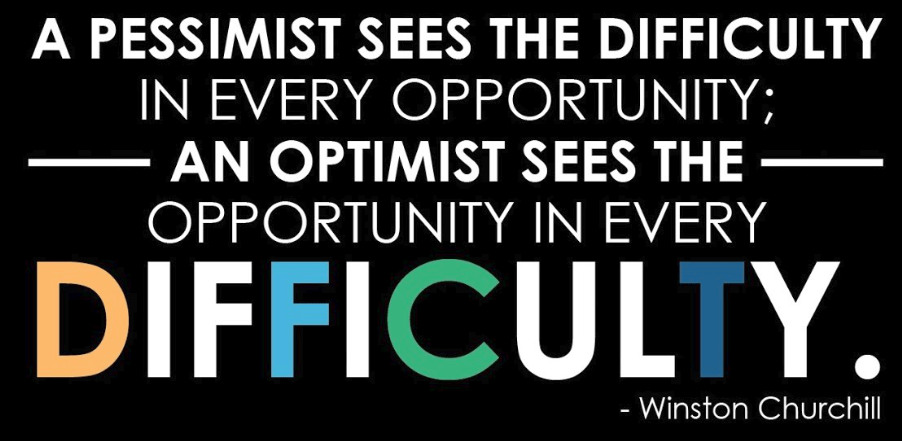
Winston Churchill once said, “The pessimist sees the difficulty in every opportunity; the optimist sees the opportunity in every difficulty.” Differently worded, an optimistic person and a negative person experience the exact same event, but interpret it differently. The pessimist sees nothing but obstacles and problems while the optimist sees mostly opportunities and positive occasions.

For instance, going back to school is an event that tends to be approached differently by optimists and pessimists. The optimist has a perpetually positive outlook and says to herself, “I can do this.” School is not too hard for the true optimist. If they struggle in school or do not fully understand the material, they pull their resources together. They ask teachers and classmates for help. They seek to understand the material on their own time. Optimists find opportunities to conquer challenges.

Pessimists might not be enjoying their current state of affairs in life, but they also give up too quickly due to negativity. School is too hard for them because they perceive it in that manner. School is too expensive. School is pointless. You see the common thread…the true pessimist sees the difficulties in every situation and makes excuses to avoid taking the steps to improve his situation in life.

The moral of this piece is to change your outlook. Why should you change your outlook? It is because your life can improve dramatically if you alter the way you look at the things that occur in life. Once you start approaching various challenges in life with a more optimistic viewpoint, things will change for the better. To change your life, you must first change your thoughts. It really is your choice.

Do you have the optimism to change your life? Start by changing your career! The 7-day CNA program at Legacy Healthcare Careers is designed to deliver state-approved training. The 7-day CNA program trains students to become a nursing assistant in approximately one week. Call (682)626-5266 to enroll at Legacy Healthcare Careers CNA School today. Classes start soon.

Additionally, Legacy Healthcare Careers will be offering certified medication aide training classes to prospective students in the Dallas-Fort Worth metro area who are presently working as CNAs or direct care staff workers. Call (682)626-5266 to obtain more details on the upcoming medication aide training program.

Positive Thoughts for Students Who Think They Cannot Do It (Part One)

man in black and white polo shirt beside writing board
Photo by Pixabay on Pexels.com

Many prospective students who want to return to school are held back by an intricate framework of negative thoughts about themselves and their capabilities. In too many instances, these negative thoughts probably evolved due to prior experiences in a school setting that may have been embarrassing, low-quality, or reminiscent of failure.

Sometimes these persistently negative thoughts have arisen due to pessimistic statements made by extended family members, spouses, partners, friends or some other unsupportive individual in their lives. It is even more unfortunate when the seeds of doubt are planted by the very same people in our lives that we seemingly expect to care about us the most.

With all of the negativity in our lives, sometimes it is an uphill battle to truly believe in our abilities to accomplish our goals. The mental voice in our framework of inner thoughts tends to speak to us more loudly than any other person. Nonetheless, believing in oneself and insisting that our goals can be accomplished is always a positive thing.

We should never feel that we do not deserve success for ourselves and those we love. We should never feel that we do not deserve to enjoy the type of life that we envision ourselves living. Keep plugging away at what you want, and common sense dictates that eventually you will obtain what you want. However, you must change your thoughts in order to change your life.

POSITIVE THOUGHT NUMBER ONE: “I am proud of all the things I have accomplished up to this point.”

All accomplishments are noteworthy and should be celebrated, regardless of how small or petty they may seem at the present time. These achievements may include parenthood, child rearing, escaping from an abusive situation, accrual of five years of service on the job, and so forth. Each life experience contributes to the complex person we are today. In other words, do not be afraid to take pride in every accomplishment regardless of how insignificant it may seem.

POSITIVE THOUGHT NUMBER TWO: “I truly believe in the individual that I want to become.”

In order to create a better future, a person must first formulate a clear mental picture of a brighter future so he or she can constantly envision it. This mental picture may or may not entail a person with a strong degree of self-confidence who has stability and an awesome career that pays enough to support one’s immediate family. Whatever the case, a person needs to fully believe in the individual that he or she aspires to become.

POSITIVE THOUGHT NUMBER THREE: “I am deserving of the dreams that I have for myself and my family.”

The people who accomplish their goals and dreams generally have some character traits in common such as tenacity, grit, perseverance, confidence and assertiveness. They tend to believe that they actually deserve to succeed, so they go after their goals with an eagerness that often goes unrivaled. Once you start to believe that you are seriously deserving of the dreams that you have for you and your family, the likelihood of turning those dreams into reality increases by leaps and bounds.

Do you want to make positive changes in your life and career prospects? The 7-day CNA program at Legacy Healthcare Careers provides state-approved training that trains you to become a nursing assistant in approximately one week. Call (682)626-5266 to enroll now. Classes start soon.

Also, Legacy Healthcare Careers intends to offer certified medication aide training classes to prospective students in the Dallas-Fort Worth metro area who are already employed as CNAs or direct care staff workers. Call (682)626-5266 for more details.

Why Would Anyone Become a Medication Aide /Medication Technician?

cold winter tablet hot
Photo by Pixabay on Pexels.com

A medication aide, also referred to as a medication technician or assistive medication administration personnel (AMAP) in a handful of select U.S. states, is an allied healthcare worker whose primary responsibility is administering non-injectable prescription and over-the-counter medications to clients.

Medication aides work under the oversight of registered nurses, licensed practical /vocational nurses (LPNs /LVNs) and other members of managerial staff to set up, administer and observe the effects of clients’ medications. Medication aides also report changes in clients’ health conditions and might also be responsible for requesting reorders of prescription drugs per company policies and procedures.

Medication aides are typically found working in post-acute healthcare workplaces such as skilled nursing home facilities, personal care group homes, intermediate care facilities, assisted living facilities, retirement centers, correctional facilities, and schools. Generally, medication aides secure employment in non-hospital healthcare settings due to local regulations.

So, why would any person become a medication aide in this day and age? Well, the advantages of working as a medication aide are definitely worth mentioning. The role of a medication aide is associated with a number of tangible and intangible perks. Without further ado, keep reading to find out about the wonderful advantages of becoming a medication aide.

REASON ONE: The role of a medication aide can be incredibly fulfilling.

One of the main reasons people opt to become a medication aide is that a career in the healthcare industry can be enormously rewarding. The reality that a medication aide will work alongside other persons as a very important part of the healthcare team can produce powerful feelings of joy. In addition, the fulfillment is something intangible that the medication aide can take extreme pride in.

Medication aides also communicate with clients, thereby being in a position to put a smile on their faces or ease their anxieties. The knowledge that one person can make a positive impact by contributing to various clients’ well-being while possibly even prolonging their lives with timely medications makes the role of the medication aide meaningful and fulfilling.

REASON TWO: Flexible work schedules are available for medication aides.

Since healthcare facilities are in operation 24 hours per day, medication aides are often able to select the work schedules they would like to work. A medication aide with school-aged children can work the 7:00 am to 3:00 pm day shift while the kids are in school. Likewise, a medication aide who is single and into the party scene can work the 2:00 p.m. to 10:00 p.m. shift, enabling him or her to get off work in time to go to the club or visit late night parties.

Furthermore, the weekend double shift is an option at some facilities. Weekend work appeals to medication aides who attend school full-time during the week or simply have a preference for enjoying all their weekdays off in a row. Finally, many people are nocturnal late owls who prefer to sleep during the day while working all night. Many medication aides work the overnight shift due to 24-hour work scheduling.

REASON THREE: The working conditions of most medication aides are comfortable.

The workplace environments of most healthcare workers, including medication aides, are comfortable due to predetermined standards of cleanliness. Most individuals who work in the healthcare sector report to places of employment that are cleaned on a routine basis per protocol by housekeeping, as well as climate-controlled to promote comfort for workers, clients, family members, vendors and visitors.

Screenshot 2018-12-29 at 12.58.09 PM

In the very near future, Legacy Healthcare Careers plans to offer a brand new certified medication aide training program to prospective students in the Dallas-Fort Worth metro area who are employed as CNAs or direct care staff workers. Call (682)626-5266 for more details.

The staff of Legacy Healthcare Careers is in the initial phases of abiding by the varied regulatory steps connected with the addition of the certified medication aide classes to the school’s current nurse aide course offerings. More details will be added as the development of the certified medication aide training program reaches completion time.


Reasons to Consider a Healthcare Career (Part Six)

screenshot 2019-01-10 at 8.34.50 am

NOTE: This piece is the sixth and final post in a comprehensive six-part essay that attempts to bring light to some of the predominant reasons a person should seriously think about carving out a career pathway in the booming healthcare industry. Click here to read the first essayClick here to read the second part, and click here for part three. Meanwhile, click here for parts four and five.

The healthcare industry is absolutely booming in many geographical regions across the country. Therefore, it would make common sense that this large field would be saturated with countless job opportunities, as well as the potential for measurable growth in the long term. However, an individual needs to have enough tenacity and persistent follow-through abilities in order to enter the ranks of the healthcare industry.

Nonetheless, plenty of perks and positive aspects await the people who possess the perseverance to pursue healthcare as a career choice. A number of truly compelling reasons exist for traveling down a career pathway in the healthcare field. Parts one, two, three, four and five of this six-part series listed plenty of reasons to obtain a healthcare occupation. Keep reading to find out added info regarding even more of these reasons.

REASON 16: Entry-level healthcare jobs offer superb chances for career advancement.

An individual who enters the healthcare industry as a certified nursing assistant (CNA) can make the choice to attain additional education and occupational training to advance his or her career. A CNA can become either a medication aide (also known as a medication technician), patient care technician, phlebotomy technician, or certified medical assistant.

CNAs can also keep climbing the educational ladder to become a licensed practical /vocational nurse (LPN /LVN), registered nurse (RN), dialysis technician, medical technologist, medical lab technician, certified pharmacy technician, cardiopulmonary resuscitation (CPR) instructor, or any number of other interesting roles in the vast healthcare sector.

People in healthcare also qualify for vertical and lateral promotions. For instance, an astute nurse aide can be promoted to a staffing coordinator or central supply manager at many skilled nursing facilities. After all, a sizable number of healthcare facilities prefer to promote good employees rather than recruit talented people externally. When it comes to career advancement in the healthcare field, the sky is truly the limit!

REASON 17: Healthcare is an industry that is expanding at a fast pace.

The healthcare industry is rapidly expanding due to a number of factors, including the large wave of older persons that belong to the Baby Boomer generation who are aging and requiring health services in ever-increasing numbers. Also, the number of people in the general population is increasing in many geographical areas due to birth rates, relocation patterns, and so forth.

All of the aforementioned reasons result in grand openings and /or expansion projects of hospitals and other types of healthcare centers to meet the increased demand from potential patients and clients. If the population in a particular city is increasing at a fast pace, healthcare facilities need to be built to accommodate all the potential people who will eventually seek care.

REASON 18: A healthcare career can personally fulfill employees.

Many healthcare workers and providers find that a career in the healthcare field is personally fulfilling. When working in some healthcare roles, there can often be very intimate involvement in some of life’s most transforming moments. Some of these moments include childbirth, impending death, and everything in between. For some healthcare workers, the fulfillment they receive is invigorating in the best way possible.

Call the Legacy Healthcare Careers CNA School at (682)626-5266 to ask about enrolling in either the 7-day CNA program, the 2-week CNA class, or the 3-week CNA course in the Dallas /Fort Worth area of Texas. It is your choice. In addition, feel free to visit the school’s informative website at www.LegacyHealthcareCareers.com to find out more information about the school’s affordable nurse aide training programs. Jump-start your legacy!